
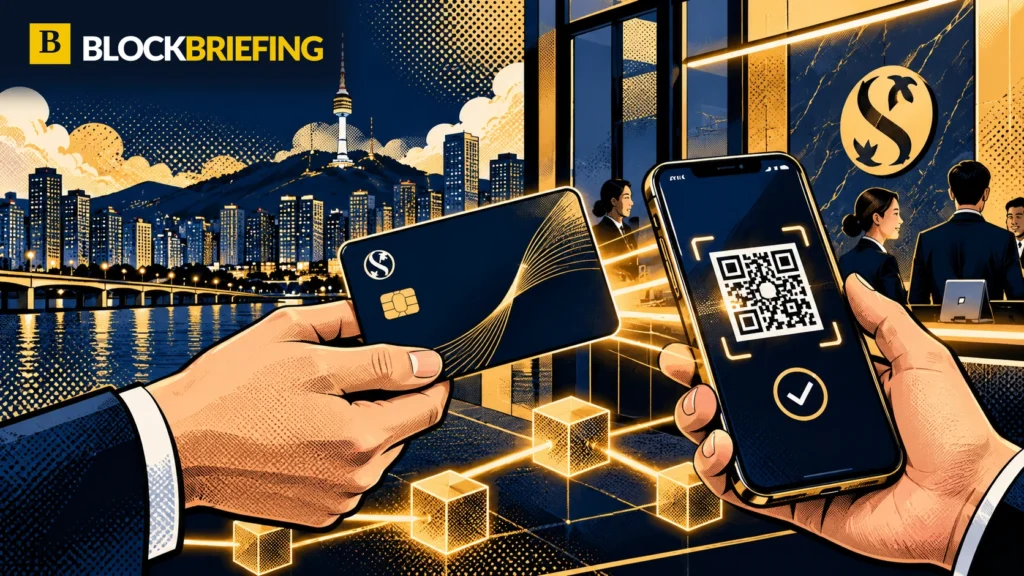
Shinhan Card is testing blockchain-based payments with Dunamu, the operator of Upbit, using the GIWA Chain network and its GIWA Wallet application. The South Korean card company announced the pilot on October 27, with employees making token-based purchases at a merchant inside its headquarters.
The limited trial is designed to test whether a blockchain wallet can handle offline retail payments while meeting security and compliance requirements. It is not a public payment-token launch or evidence that the system is ready for nationwide use.
How Shinhan Card’s payment test works
The pilot is taking place at a merchant on the basement level of Shinhan Card’s headquarters. Participating employees obtain a token issued and managed by Shinhan Card on GIWA Chain through the GIWA Wallet app, then scan a merchant QR code to pay.
According to Yonhap’s October 27 report on the announcement, users do not need to manually type in a recipient wallet address. Dunamu provides the blockchain and wallet infrastructure, while Shinhan Card remains responsible for token issuance and operation.
The pilot differs from typical public-crypto payments, where participants may send an existing cryptocurrency to any compatible address. Here, the issuer and the permitted participants are controlled within a narrow corporate test.
GIWA Chain checks eligible employee wallets
Security controls are central to the trial. The companies are using GIWA Chain’s on-chain verification system, known as Dojang, to check employee eligibility and restrict transactions to previously registered wallets.
The objective is to prevent unauthorized use and assess the controls a regulated payment company would need before launching a broader service. However, a restricted pilot cannot by itself establish transaction capacity, merchant acceptance, consumer protections or the performance of a future public rollout.
Aju Press also reported that the test is the first by a Korean card issuer using Dunamu’s GIWA Chain and dedicated wallet.
Shinhan Card considers wider blockchain payments
Shinhan Card said it has completed proof-of-concept work on six technical tasks connected with stablecoins and blockchain. The company has also explored digital-payment technology with the Solana Foundation and Japan’s SBI Group.
Its stated longer-term ambition is to expand participating merchants and explore connections with other blockchain networks once the relevant rules and technology are ready. No date for a commercial launch, public availability or confirmed fee structure was supplied in the reports reviewed.
Why the South Korea pilot matters
The announcement shows how a large card issuer is experimenting with blockchain payment infrastructure inside an existing merchant relationship, rather than launching an unrestricted cryptocurrency product. Successful employee transactions would be a useful operational test, but broader adoption will require evidence about reliability, compliance, pricing and real customer demand.
For further context, see BlockBriefing’s reporting on HSBC’s payment-token rollout in Hong Kong and its guide to stablecoins and their risks. Those are separate products and should not be confused with Shinhan Card’s experimental token.
Sources: Yonhap; Aju Press. This report distinguishes the announced pilot from a completed public launch.