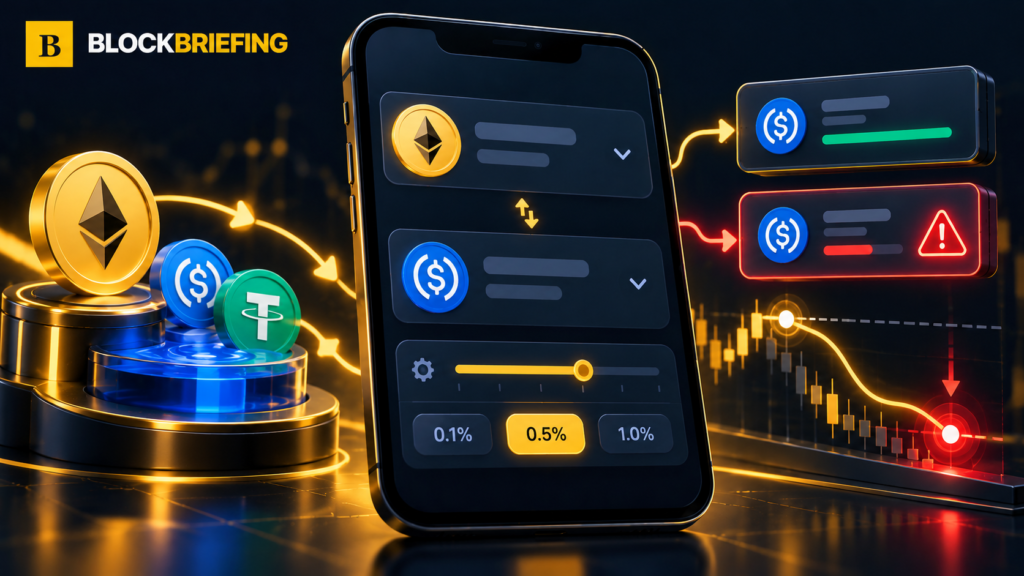
Crypto slippage is the difference between an expected trade price and the price actually received. It matters most when markets move quickly or available liquidity is limited. On decentralized exchanges, the slippage setting helps determine how far execution can depart from a quote before the swap fails.
Slippage is not automatically a scam, and a high slippage setting does not guarantee that a trade will execute. Understanding the difference between price impact and price movement while pending makes the risk easier to evaluate.
How slippage works in a crypto swap
Imagine a swap interface estimates that 1,000 units of token X will buy 500 units of token Y. Before the transaction is executed, other trades change the available price. The completed swap delivers 495 token Y units instead. The output is 5 units below the quote:
Slippage = (expected output − actual output) ÷ expected output × 100.
In this hypothetical example, (500 − 495) ÷ 500 × 100 = 1% unfavorable slippage. If the execution delivers more tokens than expected, the difference may instead be favorable. Actual swap interfaces may include other factors such as protocol fees or changed routing; compare like-for-like amounts.
Market orders on centralized exchanges can also experience slippage, because the price visible when an order is sent may differ from the price at which it is filled.
Slippage and price impact are different
Price impact describes how a particular trade itself changes the available execution price. A large swap consumes liquidity across a pool’s price range, potentially producing a less favorable average price even if no other traders intervene.
Slippage commonly describes the additional difference between the quote you accepted and what ultimately executes. In decentralized swaps, the price may move while a transaction waits for confirmation.
The Uniswap explanation of price impact and slippage distinguishes these concepts. Its developer documentation describes how price impact changes with liquidity and how slippage tolerances protect execution.
What a slippage tolerance setting actually does
A tolerance specifies how much quote deterioration the trader is willing to accept within the swap’s rules. If an interface quotes 500 token Y units and allows 1% unfavorable movement, the approximate minimum acceptable output is 495 units, assuming a straightforward exact-input swap and that the quoted output is the reference for the limit.
If the executable amount falls below that threshold, the smart contract may reject the swap. On networks that charge transaction gas for execution, a reverted transaction can still incur a fee. The exact mechanics vary by exchange and order route.
Tolerance is a limit on execution differences; it is not a promise that a trade will receive exactly the quoted price, nor is it the same as a price-impact estimate already included in the quote.
Why slippage can increase
Thin liquidity
If few tokens are available around the current trading price, even a modest order can shift the execution price. Some small token pools have limited liquidity despite large displayed market capitalizations.
Large order size
A larger trade can use more available liquidity and create greater price impact. Comparing a proposed trade with a smaller quote helps reveal whether size is affecting the estimated outcome.
Volatile prices and delays
Prices can change between submitting a trade and its execution. Network congestion or slower confirmation can increase uncertainty, although changing network fee settings is not a guaranteed solution.
Unfavorable ordering and malicious behavior
Some on-chain orders are visible before settlement. Other market participants can react to them; certain malicious ordering strategies can worsen execution. A high slippage tolerance can give more room for adverse outcomes.
A safer pre-swap checklist
- Verify the token contract, network and destination asset before looking at the quote.
- Review minimum received, quoted price impact, routing, network fee and protocol fee separately.
- Compare smaller order sizes where supported. Lowering the trade amount may reduce price impact, though it may increase total fixed fees if split into multiple swaps.
- Avoid raising tolerance merely to force an unfamiliar token trade through. Understand why the transaction would otherwise fail.
- Consider an order type with specified price conditions when the venue supports one, recognizing that execution is not guaranteed.
- Read the confirmation details in the wallet and keep a transaction hash for subsequent verification.
There is no universally correct slippage percentage. A liquid, relatively stable pair can behave very differently from a volatile or low-liquidity token. Treat interface defaults as starting points to inspect, not blanket recommendations.
What if a swap fails?
A swap can fail because output fell below the minimum, required input rose beyond its cap, an approval is missing, the route is unavailable or the transaction expired. The Uniswap safety documentation identifies minimum output checks and deadlines among common safeguards.
Do not repeatedly retry by increasing tolerance without reading the error. Verify token addresses, balances, allowances and fees. If the interface reports unusually high price impact, the safest decision may be not to trade.
Frequently asked questions
Is 1% slippage always acceptable?
No. Acceptable trade deviation depends on market liquidity, asset volatility, order size and the trader’s loss tolerance. This guide gives no universal threshold.
Does a smaller swap always have less slippage?
A smaller trade often reduces its own price impact, but pending-market movement can still cause slippage. Fees can also make smaller trades relatively expensive.
Can slippage be positive?
Yes. Actual execution can sometimes be better than a prior quote, depending on the venue and execution mechanism.
Related BlockBriefing guides
Read how to read crypto charts, risk-to-reward ratios, and transaction fees.
Primary sources and methodology
Sources: Uniswap price impact versus slippage, Uniswap developer guide to swaps, and Uniswap’s slippage explainer. Calculations are hypothetical and exclude fees unless otherwise noted.
Educational information only. Crypto swaps involve trading, custody and smart-contract risks.