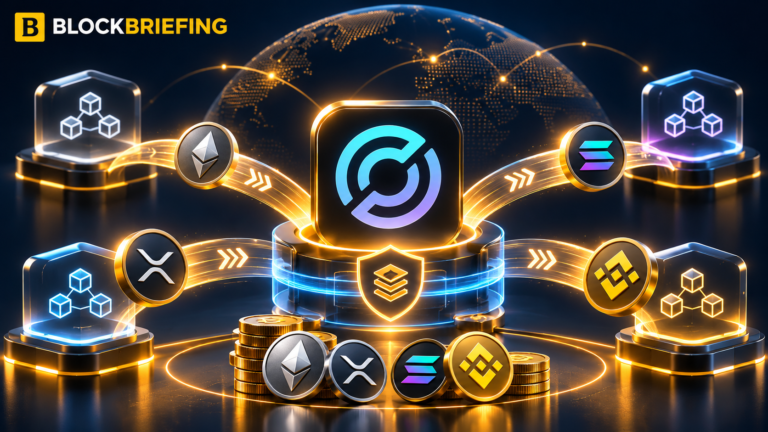
Circle has outlined how issuers can connect ERC-20 tokens other than  USDC market price and chart across supported blockchains using its Cross-Chain Transfer Protocol (CCTP) infrastructure. In an October 30 developer guide, the company described native and custom token pathways, including a deployment example on Arc Testnet.
The technical guidance expands the discussion of CCTP beyond transfers of Circle’s dollar stablecoin. It focuses on tokens that issuers operate or control, such as certain real-world-asset tokens, rather than presenting unrestricted interoperability for every token in circulation.
How cross-chain tokens move
Under the burn-and-mint model, a supported token is burned on the source chain. A message about the transaction is then attested before the corresponding token is minted on the destination chain. This approach is designed to avoid simply creating an independently circulating wrapped copy without a coordinated supply mechanism.
For non-USDC assets, Circle specifies that this process uses its CrossChainTokenService and token managers rather than the standard USDC deposit-for-burn interface. The issuer must configure token contracts and trusted connections across the relevant networks.
Two issuer-controlled approaches
The native route allows a developer to deploy a new cross-chain token using Circle’s service. The custom route connects an existing issuer-operated ERC-20 token to CCTP infrastructure. Both require configuration of operational roles, transfer limits and technical parameters before they can be used in production workflows.
Circle’s guide also outlines use of Arc Testnet to test the deployment and movement of a token between supported environments. A testnet example should not be confused with a live public launch of a particular token or with a promise that all routes are available on mainnet.
What developers and users should know
Cross-chain systems introduce practical risks, including smart-contract vulnerabilities, incorrect recipient addresses, chain configuration mistakes and transaction fees. Circle emphasizes that issuers remain responsible for their tokens and applicable compliance requirements.
The development has implications for applications using stablecoins and tokenized assets for collateral, settlement or treasury movements. Readers new to the category can review BlockBriefing’s stablecoin explainer and transaction-confirmation guide.