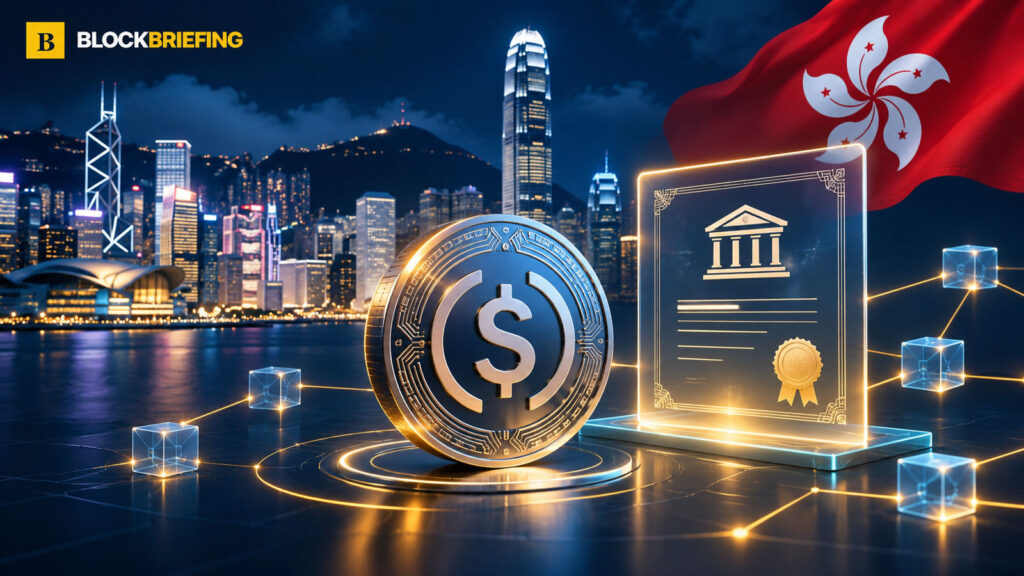
Hong Kong’s monetary authority plans to test regulated stablecoins as part of its work on tokenized securities settlement, extending an institutional initiative that has already examined secondary-market transactions in tokenized Exchange Fund Bills.
The Hong Kong Monetary Authority announcement on November 2 outlined the next phase at Hong Kong FinTech Week.
Tokenized Securities Enter Settlement Trials
According to the HKMA, recognized dealers have completed trial secondary-market trades involving tokenized Exchange Fund Bills. These are short-term debt instruments issued as part of Hong Kong’s established monetary infrastructure.
The regulator said the work illustrated potential efficiency improvements in securities trading and repurchase agreements, or repos, which institutions commonly use for short-term secured financing.
Regulated Stablecoins Could Be Next
Future tests will examine the use of regulated stablecoins in the settlement process. Stablecoins seek to maintain a stable value against a reference asset, often fiat currency, and could offer a different payment instrument from tokenized deposits or tokenized central bank money.
The regulator has not announced the public deployment of a stablecoin settlement system for Exchange Fund Bills, nor provided a confirmed timetable for completing the planned trials.
The stablecoin proposal also differs from Hong Kong’s Project Ensemble expansion to around-the-clock interbank settlement of tokenized bank deposits using central bank money.
Hong Kong Develops Regulated Tokenization
Both initiatives underscore the city’s efforts to test digital representations of financial assets within supervised banking and securities infrastructure. The next meaningful evidence will be the outcome of live institutional trials, including how risks, compliance and settlement reliability are managed.
How Settlement Assets Change the Process
Trading a tokenized security and settling that trade are separate steps. A transaction may represent the transfer of a digitally recorded security, but the buyer still needs to deliver an acceptable payment asset. If the transfer of the security and payment can be coordinated, institutions may be able to reduce the time during which one party has performed while the other has not. Whether such benefits appear in practice depends on the design of the settlement system and the rules governing participating institutions.
Regulated stablecoins are one possible payment instrument. Their usefulness in institutional settlement depends on redemption rights, reserve arrangements, transfer controls and legal recognition, not solely on the speed of blockchain transactions. Those considerations help explain why the HKMA described further testing rather than announcing a broadly available live securities settlement service.
Why Exchange Fund Bills Are Relevant
Exchange Fund Bills are established money-market instruments, making them a useful test case for integrating tokenization with familiar financial-market functions. Their secondary-market trading also intersects with repurchase agreements, in which securities are transferred as collateral against short-term funding. Tokenized records could potentially simplify parts of those workflows, but collateral eligibility, settlement finality and participant access remain critical.
The reported trials involving recognized dealers therefore provide a more specific signal than a general announcement about blockchain interest. They test activity tied to existing securities infrastructure and can help identify requirements for custody, collateral mobility and reconciliation between conventional and tokenized systems.
What to Watch in Later HKMA Updates
Readers should look for the identity and regulatory standing of stablecoins accepted in future tests, the payment-versus-delivery mechanism, and whether settlement can be finalized reliably when different systems are involved. Other useful indicators include the number and type of participating institutions and any disclosed limits on transaction size or operating hours.
These details would clarify whether regulated stablecoin settlement adds a capability beyond the HKMA’s parallel work with tokenized central bank money. Until those findings are published, the distinction between a planned experiment and an operational market infrastructure remains important.