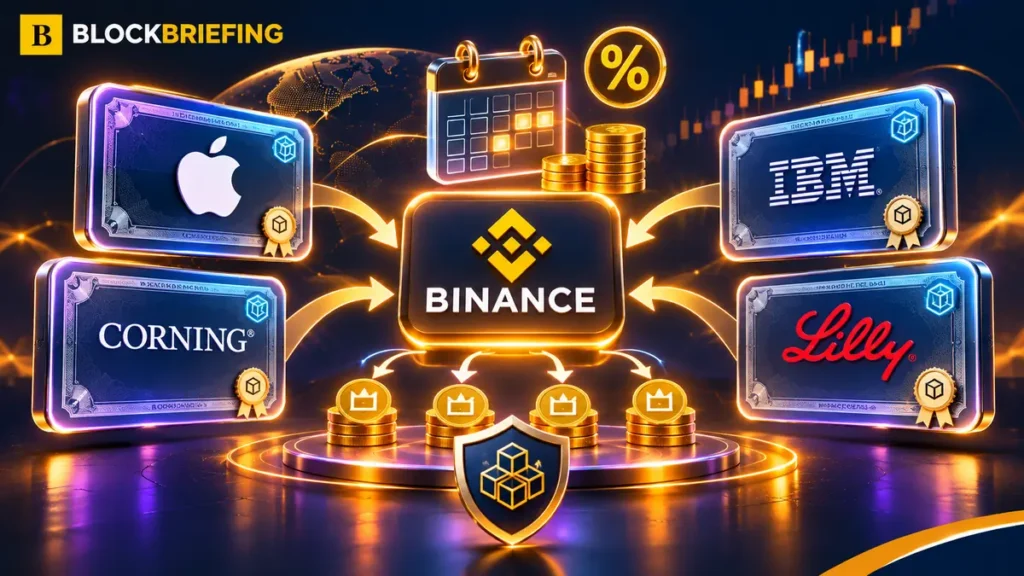
Binance has announced dividend distribution procedures for tokenized securities linked to IBM, Apple, Corning and Eli Lilly. The arrangements cover IBMB, AAPLB, GLWB and LLYB certificates, with eligibility snapshots scheduled between November 10 and November 13. Customers will receive reinvested value in the relevant bStocks instruments rather than a conventional direct stock dividend.
Binance’s November 6 dividend notice says eligible dividend amounts will be reinvested after withholding taxes and applicable costs. The exchange makes clear that these bStocks are certificates representing an interest in underlying securities held by the issuer, BTech Holding Limited, rather than direct ownership of shares in the named companies.
Eligibility snapshots begin November 10
The scheduled UTC snapshot for IBMB is November 10 at 00:00. The AAPLB snapshot follows November 12 at 00:00, and GLWB and LLYB snapshots are set for November 13 at 00:00. Holders must meet the relevant eligibility conditions at the stated times. The schedules should not be confused with a universal dividend date across all four companies.
Binance says token conversion, deposits and withdrawals for IBMB will pause at 23:30 UTC on November 9. Equivalent restrictions are scheduled for AAPLB on November 11 and for GLWB and LLYB on November 12. The exchange says spot trading in the related  USDT market price and chart pairs will not be affected by these particular suspensions.
How tokenized certificate dividends work
Eligible users will be credited with additional certificate units or fractions following reinvestment of the net cash dividend. Binance says on-chain holders will receive the benefit through a multiplier adjustment. This differs from holding registered stock and receiving a conventional dividend through a traditional brokerage account.
The distinction is material for consumer understanding. Tokenized certificates may expose investors to issuer, custody, operational and regulatory risks in addition to changes in the market value of their referenced assets. A certificate holder does not automatically obtain the voting and ownership rights associated with directly registered shares.
Regional availability is restricted
Binance states that the certificates are offered through an approved prospectus in Abu Dhabi Global Market and are not offered in other jurisdictions. The availability of tokenized securities should not be inferred from broader access to Binance’s cryptocurrency products. Users should examine the governing prospectus and terms before considering eligibility.
Services are expected to resume after dividend processing, with no additional reopening announcement promised. The company reserves the ability to modify the notice, making its official support page the definitive place to check for changes. Investors should also account for applicable taxes, deductions and product-specific risks before equating a tokenized distribution with a direct equity dividend.
The mechanics also matter when comparing transaction records. A multiplier adjustment to an on-chain certificate can change the economic quantity associated with a holding without resembling a conventional cash credit. Investors should retain accurate records of purchases, distributions and conversions for their own financial reporting. Binance does not promise that every service will reopen at a fixed time after processing, and changes to the distribution timetable are possible. Customers should verify the final eligibility snapshots in the issuer and exchange documentation before taking any action.