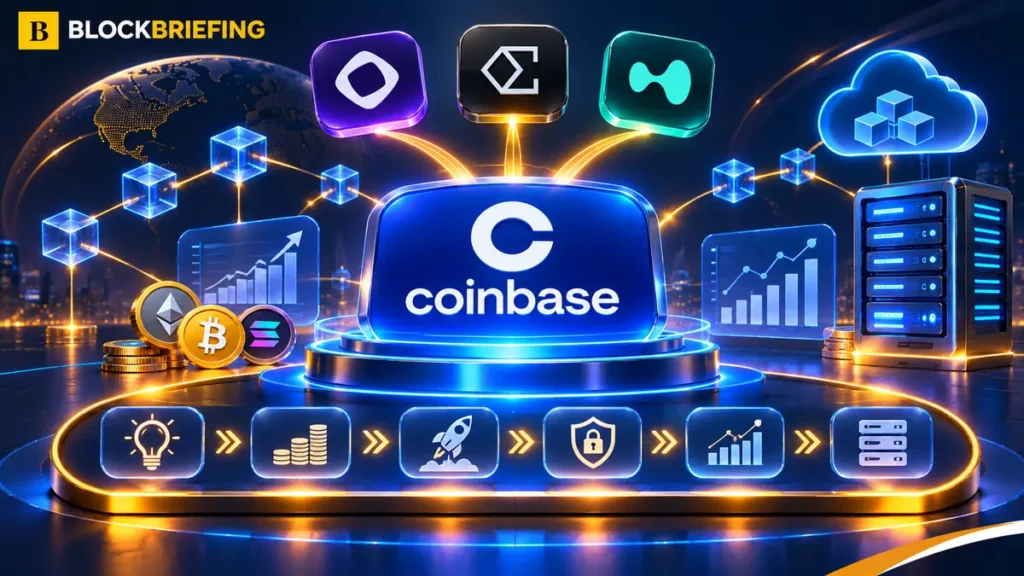
Coinbase is promoting a package of infrastructure services designed to support cryptocurrency projects from initial token fundraising through their later operations. A November 5 company publication points to projects associated with Monad, Ethena and Hyperliquid as examples of how a blockchain protocol may use different parts of its service portfolio.
Coinbase’s overview of its token lifecycle platform describes token sales and longer-term infrastructure support, while directing prospective customers to Coinbase for Issuers. Its statements are company descriptions of products and relationships rather than independent proof that those services improve project returns or guarantee successful launches.
A wider offering than trading and listings
Coinbase is seeking relationships with blockchain teams before tokens begin secondary-market trading. Potential infrastructure requirements include fundraising administration, custody, token distribution, technical integrations and ongoing service arrangements. Using one vendor for several functions can reduce the number of systems a team must integrate, but can also concentrate operational dependencies.
A token issuer still faces obligations involving investor disclosures, regulatory compliance, allocation policies and risk management. Commercial access to an established platform does not automatically satisfy those obligations. Coinbase’s discussion is primarily about how it packages services, not a declaration that all token projects qualify for every offering.
Monad, Ethena and Hyperliquid illustrate different uses
Coinbase says an affiliate of the Monad Foundation conducted a public token sale through its token-sales infrastructure. It cites Ethena as an example of a launch relationship extending into ongoing support and Hyperliquid as a protocol that used Coinbase infrastructure in its scaling activities. These are distinct relationships, not necessarily identical service contracts.
The company did not present a uniform framework for assessing the independent outcomes of those examples. Token sale participation, protocol expansion and secondary-market trading performance are different measures of success. Investors should not assume that a Coinbase service relationship constitutes an endorsement of a token’s investment prospects.
Issuer platforms raise governance questions
As exchanges expand into the infrastructure used by token issuers, questions emerge about separation between business development, listing decisions and independent compliance reviews. Protocols may benefit from fewer contractors while still requiring clear safeguards around custody, disclosure and conflicts of interest.
The announcement does not provide a universal fee schedule or independently audited adoption figures for the newly highlighted issuer business. Future transparency on customer numbers, contractual safeguards and how token-sale services interact with exchange listing policies would help the market evaluate the offering beyond its marketing claims.
Coinbase’s move also highlights competition among crypto infrastructure providers to capture recurring relationships with developers. For project teams, the relevant comparison is the total service offering and associated risks, not just the brand recognition of any one platform.
Even a technically sophisticated token launch can face issues involving concentration of supply, liquidity, governance or security after distribution. Outsourcing launch operations does not shift all of those responsibilities onto a service vendor. Teams evaluating Coinbase’s issuer offering should examine how assets are safeguarded, who controls administrative keys, how operational incidents are handled and whether any third parties remain involved. Public details about these safeguards would help distinguish a comprehensive infrastructure platform from a bundle of separately available commercial services, while allowing market participants to compare competing approaches on evidence.