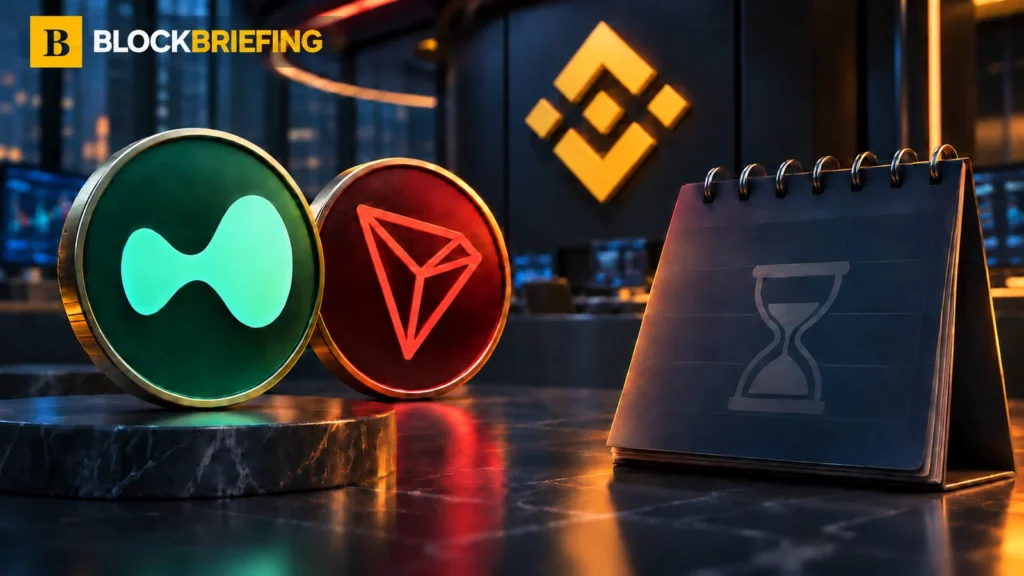
Binance has moved the launch of its HYPEUSDC and TRXUSDC perpetual futures to November 16, according to an updated official notice. The revision supersedes the original November 11 timetable, meaning older search snippets showing a launch today no longer reflect the exchange’s current schedule.
The updated announcement now schedules HYPEUSDC for 08:30 UTC and TRXUSDC for 08:35 UTC on November 16. In Pakistan, those times are 1:30 p.m. and 1:35 p.m. The exchange explicitly records that it amended the launch date on November 11.
Updated Exchange Notice Supersedes The Earlier Launch Timetable
HYPEUSDC references Hyperliquid’s HYPE token, while TRXUSDC references TRON market price and chart’s TRX. Both contracts settle in USDC market price and chart, and Binance lists maximum leverage of 75 times. The notice gives HYPEUSDC a four-hour funding interval and TRXUSDC an eight-hour interval.
The notice sets a 0.001 tick size and a minimum order of 0.01 HYPE for HYPEUSDC. For TRXUSDC, it lists a 0.00001 tick size and a one-TRX minimum. Both require a minimum notional value of five USDC. These are separate conditions: an order can satisfy the token-quantity floor while remaining below the minimum trade value. Binance reserves the right to revise trading parameters, so the live contract rules remain important before the scheduled opening.
The exchange has not given a reason for the schedule change in the notice. The revision alone does not establish a technical fault, liquidity problem or issue with either blockchain. Those explanations would require additional evidence. The confirmed development is a changed derivatives launch timetable.
Funding Intervals Differ Despite The Shared Settlement Asset
A common settlement currency does not make the two contracts identical. Funding frequency, price increments and order-size requirements vary by instrument. Traders comparing the products therefore need to review the specifications for each contract instead of assuming that the HYPE and TRX markets use the same operating parameters.
Binance’s perpetual futures documentation also illustrates why underlying asset type matters: continuous crypto markets differ from futures referencing traditional assets with scheduled market closures. In both cases, a derivatives position remains subject to margin and funding mechanics rather than simply behaving like an unleveraged asset holding.
Revised Listing Dates Do Not Establish Price Direction
The announcement contains no reliable basis for forecasting a rise or fall in either token. A new futures pair changes the available contract lineup, but future prices depend on trading and wider market conditions. This report does not infer a bullish or bearish outcome from the postponement.
The high headline leverage also needs context. At 75 times leverage, an illustrative 100-USDC initial margin could correspond to 7,500 USDC of exposure before account limits and costs. A 1% unfavorable move would equal 75 USDC on that exposure. Maintenance margin and fees can trigger liquidation before a trader loses the full starting margin.
BlockBriefing’s reporting on changes in XRP futures positioning examines how derivatives activity can differ from spot-market conditions. Its crypto market data page provides separate asset-price context. Neither source establishes how the new HYPE or TRX contracts will trade. The next checks are Binance’s latest notice and the markets’ actual opening status on November 16. Cached search results should not override the revised launch schedule.