
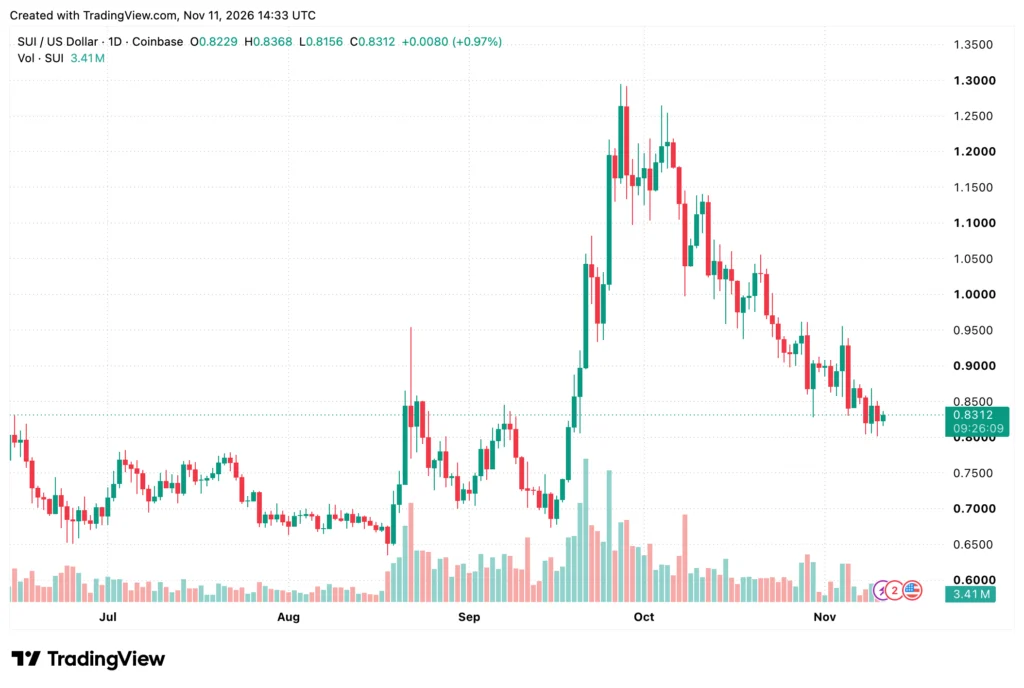
The SUI market price and chart crypto price traded around $0.82 on November 11, 2026, as a month-long decline and weak daily momentum focused attention on the $0.80 support area. Traders were also monitoring whether futures positioning and broader Bitcoin market price and chart leverage would increase volatility across altcoins.
TradingView’s SUI/USD market overview indicated a decline of approximately 26% over the preceding month, while CoinMarketCap put SUI’s market capitalization at approximately $3.4 billion. The price and market-cap figures reflect reporting-time snapshots and can vary among exchanges.
SUI Crypto Price Trades Near Critical Support Levels
CoinMarketCap’s November 11 market snapshot recorded an intraday range of approximately $0.8038 to $0.8419. The lower end put SUI within striking distance of $0.80, but a brief test of that area would not by itself confirm a longer-term breakdown.
SUI also remained substantially below its January 2025 all-time high of about $5.35. The distance from that peak highlights the depth of the correction, rather than independently proving whether the current price is undervalued.
The weakness follows broader cryptocurrency selling discussed in BlockBriefing’s November 10 market report. SUI’s next short-term direction remains conditional on whether buying interest can hold around $0.80 and then lift prices through resistance.
Daily Indicators Keep The Broader Trend Under Pressure
Daily readings from COINOTAG’s SUI technical dashboard, updated at 07:57 UTC on November 11, placed the 14-period Relative Strength Index near 37.5. That reading signals comparatively weak momentum, though it remains above the conventional oversold threshold of 30.
The same dated calculation identified first resistance near $0.8355, additional resistance near $0.8582, and support around $0.7984 and $0.7679. Its daily MACD reading was negative and its evaluated moving averages remained bearish. These levels are generated technical references, not guaranteed turning points.
Signals can differ by platform and timeframe. For example, Investing.com’s November 11 technical snapshot showed a less bearish shorter-timeframe oscillator reading while its 50-, 100- and 200-period moving averages still showed selling signals. An intraday improvement should therefore not be confused with a confirmed daily trend reversal.
CryptoPatel’s Earlier Bullish Scenario Meets Current Price Reality
Crypto analyst CryptoPatel previously discussed a conditional SUI recovery scenario in an October 15 post, identifying a potential re-entry region between $1.00 and $0.75. His earlier bullish-confirmation level was $1.4223, with higher upside targets dependent on a sustained recovery. The figures were republished in a October 15 X post; they are not independent price forecasts by BlockBriefing.
The user’s supplied November 11 CryptoPatel X post could not be fully accessed for this review. Its specific language and any newly presented targets have therefore not been attributed to the analyst.
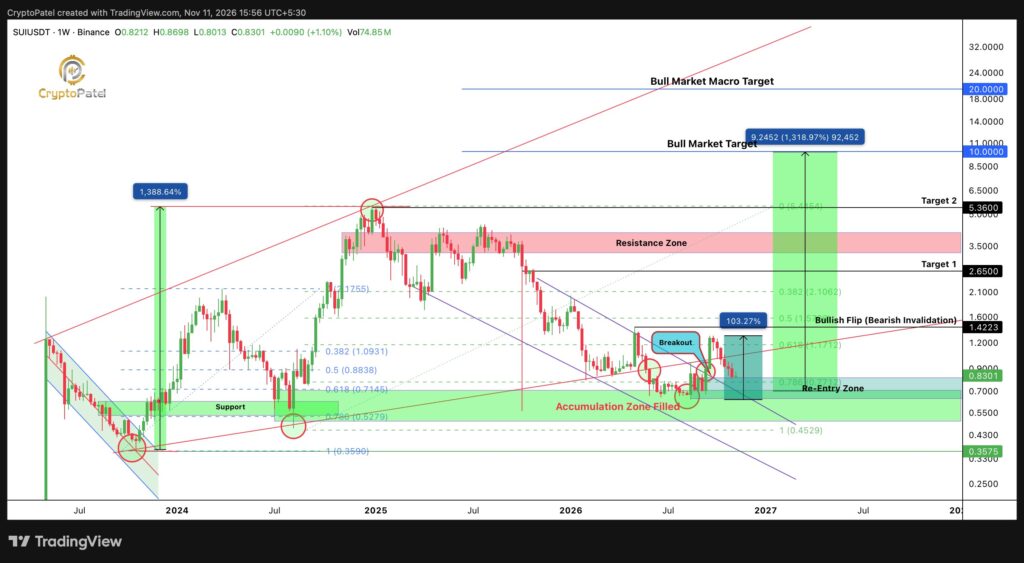
SUI trading near $0.82 places the token within the broad area discussed in the analyst’s older scenario but well below the cited $1.4223 confirmation threshold. That distinction matters: a possible accumulation zone is not evidence that accumulation has occurred, and no chart-based scenario removes downside risk.
SUI Futures Positioning Suggests Traders Are Reducing Risk
Derivatives activity offers a second measure of market participation beyond spot prices. CoinGlass’s SUI open-interest dashboard tracks outstanding futures contracts across participating venues.
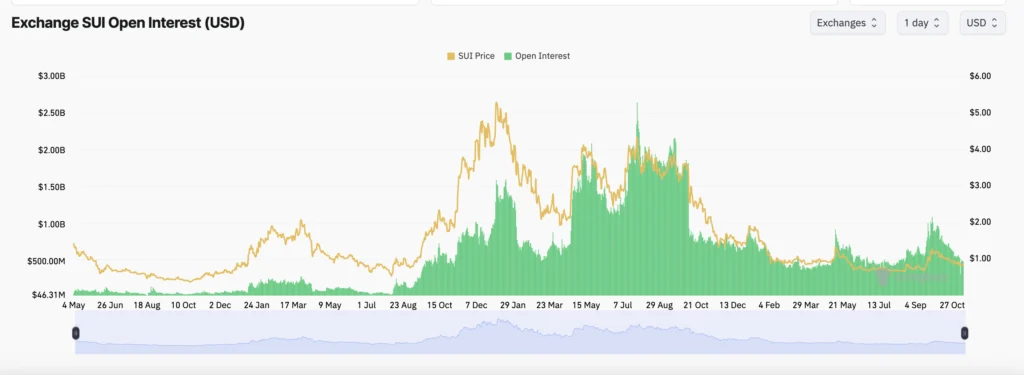
Rising open interest means more positions remain outstanding, but it does not identify the direction of net speculative conviction on its own.
Falling prices accompanied by declining open interest may be consistent with position closures or forced deleveraging, whereas rising open interest during a decline can reflect fresh long or short exposure.
Interpreting either move requires exchange-level funding, liquidations and spot-volume context. No unverified live open-interest total is used in this report.
Bitcoin Open Interest Adds Important Market Risk Context
The CoinGlass Bitcoin open-interest dashboard supplied for this analysis tracks derivatives exposure in Bitcoin, not SUI. It is useful for gauging potential market-wide leverage conditions, but its figures cannot be represented as SUI futures positions.
If Bitcoin experiences sharp liquidations or a disorderly reduction in leverage, liquidity conditions can tighten across other cryptocurrencies. Conversely, calmer derivatives trading does not guarantee a SUI rebound. The publicly accessible Bitcoin dashboard did not provide a verifiable aggregate numeric reading during this review, so this report does not claim one.
Readers can compare the wider market in BlockBriefing’s cryptocurrency market data dashboard, while treating continuously changing metrics as snapshots rather than permanent values.
Network Adoption News Has Yet To Reverse Weakness
The token’s decline has occurred alongside announced ecosystem integrations. In an October 8 announcement, the Sui Foundation said Samsung Wallet would integrate USDC market price and chart transfers using Sui, potentially reaching eligible users across approximately 82 million Galaxy devices in the United States.
That arrangement concerns USDC transfers over the Sui network, not a confirmed direct SUI-token listing in Samsung Wallet. Sui’s fee-free stablecoin infrastructure can also permit supported transfers without users holding SUI, limiting any automatic connection between transaction growth and token demand.
On October 29, the Foundation announced an integration with Mercado Bitcoin involving SUI, USDC and Sui Dollar, with further plans involving lending and tokenized assets. Some broader initiatives, including a potential Hashi integration, were described as exploratory rather than immediately available services.
These announcements provide possible routes for wider adoption, but partnership announcements alone are insufficient to establish sustained demand or an imminent change in market structure.
Price Scenarios For SUI Depend On These Levels
A sustained move back above approximately $0.8355 would improve the immediate technical picture. Clearing the next reference around $0.8582 could bring the $0.90 region into view, particularly if momentum, spot volume and higher-timeframe closes improved together.
A daily close below approximately $0.7984, on the other hand, would weaken the support case and shift attention toward approximately $0.7679. The $0.80 area remains an especially visible psychological level, but it is not a guaranteed floor.
For now, the SUI crypto price remains sensitive to its own trend structure and the wider digital-asset market. Technical confirmation, actual on-chain adoption and independently verifiable derivatives activity will provide more reliable evidence than isolated bullish or bearish forecasts.
Market data reflects source-specific observations dated November 11, 2026. Figures may differ across venues and update after publication. This article is for information only and is not investment advice.