 Ethereum market price and chart can get busy. When lots of people use it at the same time, transactions may become expensive. Layer 2 networks are one way developers try to make using Ethereum faster and more affordable.
Two terms you’ll often hear are optimistic rollups and ZK rollups. Their names sound complicated, but the basic idea is straightforward.
What is a rollup?
Picture a busy checkout counter. Instead of asking the main counter to handle every small task separately, another team handles many tasks and sends back a summary.
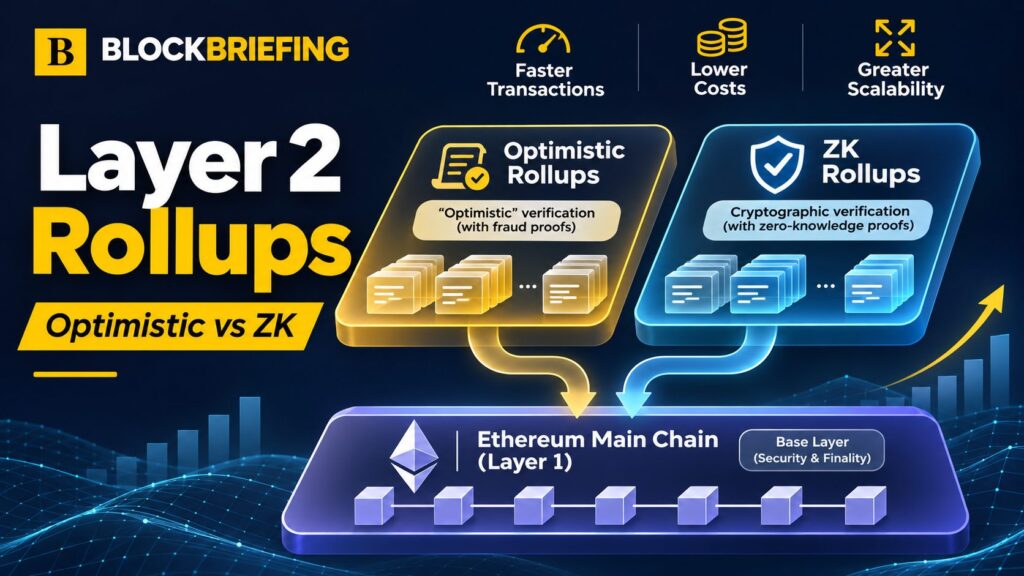
A rollup works somewhat like that. It processes transactions away from Ethereum’s main network, then sends information or proof about those transactions back to Ethereum. This can reduce costs and help more people use apps at the same time.
What is an optimistic rollup?
An optimistic rollup generally accepts a batch of transactions unless someone challenges a mistake. It needs a way for others to raise disputes and prove that something went wrong.
Because of this challenge process, moving funds from some optimistic rollups back to Ethereum can take longer. Services may offer quicker exits, but those can introduce additional risks or fees.
What is a ZK rollup?
A ZK rollup uses a mathematical proof to show that its transaction calculations follow the rules. Ethereum can check that proof instead of repeating all the work.
These proofs can be difficult to create, and each network has its own design. Also, the “ZK” label doesn’t mean all your transactions are automatically private.
What’s the difference?
- Optimistic rollups: focus on letting people challenge incorrect results.
- ZK rollups: use mathematical proofs to demonstrate that results follow the rules.
- Both: aim to help Ethereum handle more activity, but each comes with different design choices and risks.
Are layer 2 networks safe?
No blockchain system is risk-free. Some networks still rely on a small group of operators or on upgrade controls. Bridges, which move assets between networks, can also have security weaknesses.
Before moving money, check which network you’re using, whether your wallet supports it and how withdrawals work. Our crypto bridges guide explains those transfers.
How can a beginner get started?
- Choose a supported network and confirm its official details.
- Check that your wallet supports that network.
- Make sure the token and receiving address are correct.
- Read the fees and withdrawal conditions before transferring.
- Try a small transfer first if that makes sense for the amount involved.
Quick questions
Are all layer 2 transfers cheap?
No. Fees can rise when demand increases.
Is a sidechain the same as a rollup?
Not exactly. A sidechain typically relies on its own security system, while a rollup is designed to use Ethereum for important parts of settlement or verification.
Learn more: Ethereum’s layer 2 introduction and its ZK rollup guide.