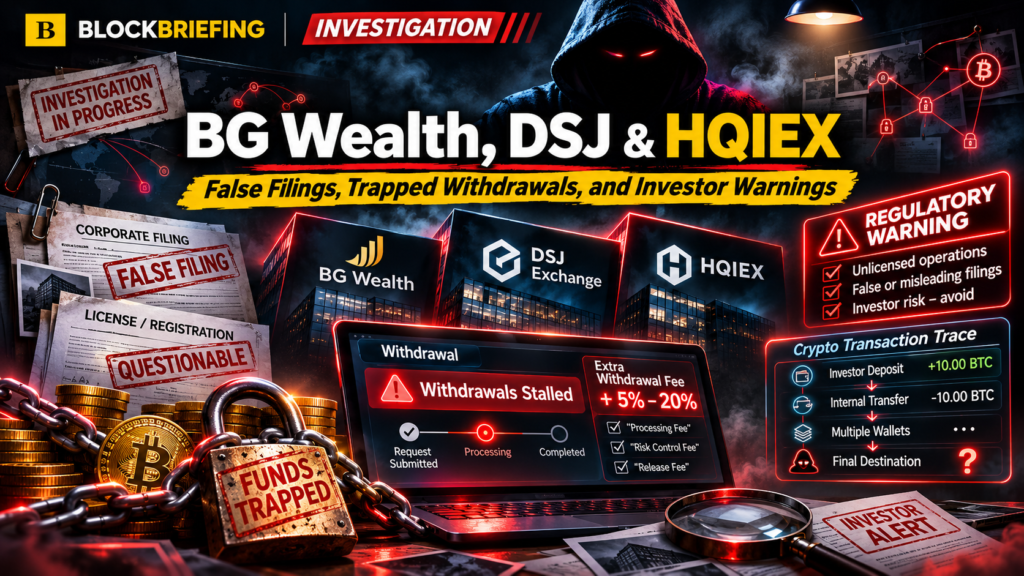
Investigation | Document-based reporting: Federal and Washington state records describe how BG Wealth Sharing Ltd and DSJ Exchange Pty Ltd allegedly used public regulatory filings, inflated trading balances and a recruitment network to attract cryptocurrency deposits. The most revealing part of the record is what happened after authorities began warning investors: demands for additional withdrawal payments, an attempted move to HQI Exchange (HQIEX), and a later filing under another corporate name.
The US Securities and Exchange Commission filed a civil complaint on October 29, 2026, accusing BG Wealth and DSJ Exchange of taking more than $130 million through an investment program that promised extraordinary, supposedly risk-free returns. The allegations have not been established by a final court judgment. The case is SEC v. BG Wealth Sharing Ltd and DSJ Exchange Pty Ltd, No. 3:26-cv-12746, in the Northern District of California.
How a public filing became a claim of approval
The operation claimed that a figure identified as “Professor” Stephen Beard had developed trading signals with 99.6% accuracy. According to the SEC, marketing promised returns of at least 60% per month and said investors could double their principal in 40 days without risk. DSJ Exchange displayed what looked like trading profits and growing account balances. The SEC alleges the represented trades did not take place and the displayed profits were fictitious.
The filings were central to the pitch. BG Wealth filed a Form ADV as an exempt reporting adviser, while DSJ Exchange submitted a Form D for a purported securities offering. According to the complaint, promoters pointed investors to those publicly searchable documents and displayed fabricated certificates bearing the SEC seal. Neither a Form D filing nor an exempt reporting adviser filing amounts to an SEC endorsement of a company’s investments. The SEC said neither defendant was registered with it and has removed the disputed filings.
The complaint also describes alleged false supporting details: BG Wealth listed a commercial mailbox as its office, named an auditor that the SEC says was not identifiable as a public accounting firm, and provided contact information that regulators could not use. The complaint says a notary whose stamp appeared on DSJ Exchange’s filing had not notarized it. These details suggest the public-facing filing record was used to create credibility even as the regulator says its contents were unreliable.
The warnings came before the federal lawsuit
The timeline is important. The SEC alleges at least seven overseas securities regulators had issued warnings beginning in May 2025. US state authorities also raised concerns in 2026. Washington’s Department of Financial Institutions published an investor alert on April 10 and later updated it with reports of withdrawal problems and demands for new payments. On May 26, Washington entered a summary order and statement of charges requiring the companies to cease violations of the state’s securities law. The respondents had the right to request a hearing.
That means the October federal case did not mark the first public warning. The SEC alleges BG Wealth and DSJ Exchange continued attracting funds into June 2026 despite earlier notices and enforcement actions.
When withdrawing money allegedly required paying more
The complaint describes early withdrawals that helped build trust, followed by fees as high as 20% and delays. After the FBI seized a principal BG Wealth domain on April 23, the SEC alleges that Beard blamed a supposed Chinese hack rather than acknowledging the law-enforcement action. DSJ Exchange later stopped withdrawals altogether, according to the complaint.
Washington regulators described a related advance-fee pattern: investors were told a regulatory audit required a new payment equal to 12% of their account value before they could withdraw. The department reported that some people who paid still could not retrieve their investment. These reports should not be mistaken for proof that every participant faced the same charge or experienced the same outcome.
HQIEX: the proposed second destination for trapped funds
The next step was a claimed migration. Washington’s May 15 alert update said investors were being directed away from DSJ Exchange to HQI Exchange, also called HQIEX, and asked to send more money. Its May 26 announcement described reported sign-up demands of $100 or $1,000, supposedly so balances from the earlier platform could be moved.
The SEC’s October complaint echoes the mechanism: it alleges investors who were already unable to withdraw were asked to make new deposits to transfer their funds to HQIEX. According to the SEC, paying did not restore access to the assets. The public records reviewed here do not independently establish HQIEX’s full ownership structure or the ultimate destination of every additional payment. It would be inaccurate to present the supposed migration as a legitimate transfer of customer assets.
One more filing: Horizon Crest Capital
A less obvious detail appears in paragraph 76 of the SEC complaint. The agency alleges that, on September 29, 2026, DSJ Exchange changed its EDGAR name to Horizon Crest Capital Inc., a purported New York corporation, and filed another Form D. The SEC characterizes this as an apparent attempt to prolong the misconduct. The filing event is described in the complaint; the motive remains the SEC’s allegation, not an independently established conclusion.
That episode matters because the earlier alleged deception relied on presenting regulatory database entries as an approval badge. The September filing indicates why an investor should not treat an official filing receipt or searchable company record as proof that a platform is safe.
Following the money: what the blockchain evidence does and does not show
The SEC says the defendants received more than $130 million from over 223,000 blockchain addresses between March and early June 2026. The complaint says deposits included  USDC market price and chart,
 USDT market price and chart and
 ETH market price and chart. It alleges funds moved across blockchains and intermediaries, in some cases through common addresses, rather than financing the advertised trades. No more than $25 million was sent back to addresses likely associated with investors in what the agency describes as Ponzi-like payments. The SEC alleges aggregate investor losses exceeded $100 million.
Evidence boundary: Those are figures from federal investigators. BlockBriefing has not independently reproduced the transaction tracing or verified a complete list of deposit and intermediary wallets. One person can control multiple blockchain addresses, and some addresses may belong to custodial services; 223,000 addresses should not be described as 223,000 unique victims. Nor does the difference between reported receipts and return payments, by itself, establish the precise recoverable balance at any specific date.
Recruitment gave the operation reach
The SEC and Washington regulators describe an extensive recruiting structure. Social media posts, encrypted messaging groups, livestreams, live meetings and events helped introduce new investors. Recruiters were reportedly offered extra trading signals, bonuses, commissions or other benefits for bringing in participants. The SEC says some of the incoming funds were used for payments that reinforced the appearance of real profits.
The distinction is important: the presence of an apparent payout does not prove the underlying trading strategy earns money. Regulators allege early payments helped keep the operation going and encouraged further deposits.
What is documented, alleged and still unanswered?
Documented public actions: Washington issued investor notices and a May 26 summary order; the SEC filed a civil complaint on October 29 and announced its charges. Those filings and regulatory actions can be independently verified from government records.
Agency allegations: The promised profits were fabricated; investor deposits were diverted; public filings and certificates were misrepresented; investors were pressured to make extra withdrawal and HQIEX payments; and the Horizon Crest filing was connected to an attempt to continue the operation. These conclusions remain allegations in a pending civil matter unless independently established or adjudicated.
Outstanding questions: Who ultimately controlled the receiving wallets and overseas operations? What proportion of the reported funds can investigators freeze or recover? How many people, rather than addresses, experienced losses? What relationship, if any, existed between HQIEX’s operators and the later Horizon Crest filing? And what response do the defendants or their legal representatives offer to the specific allegations?
BlockBriefing has not obtained a direct response from the defendants or their representatives during preparation of this report. This article should be updated if an attributable response or material court development becomes available.
What affected investors should know
Washington regulators cautioned investors against sending further money to purported recovery or successor services. Anyone who believes they were affected should preserve wallet addresses, transaction hashes, platform statements and correspondence and consult relevant law-enforcement or regulatory reporting channels. An upfront recovery payment is not proof that funds will be returned.
This document-led analysis expands upon BlockBriefing’s earlier report on the SEC’s $130 million allegations. It should be read as an examination of the regulators’ evidence and timeline, not as an independent forensic certification of all crypto flows.
Primary documents and methodology
- SEC complaint, filed October 29, 2026, especially paragraphs 1–9, 44–56 and 69–76.
- SEC announcement, October 29, 2026.
- Washington investor alert, April 10, with May updates.
- Washington enforcement announcement, May 26, 2026.
- Washington summary order and statement of charges.
Reporting note: Sources are official regulatory filings and announcements. Blockchain flow totals are attributed to the SEC. No independent wallet-by-wallet tracing, interviews with affected investors or defendants’ responses are claimed. Prepared November 1, 2026 (UTC); not yet published.