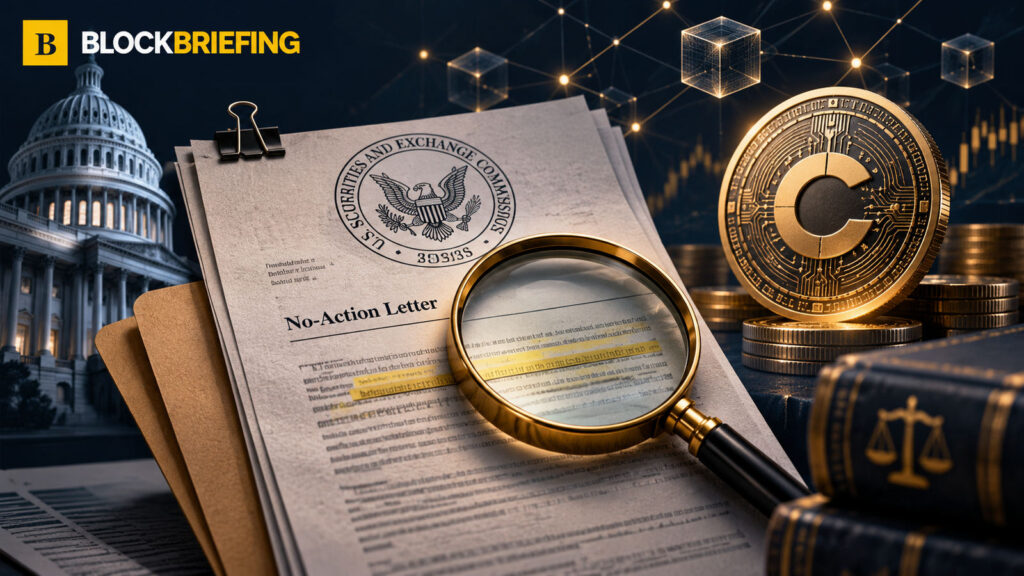
The United States Securities and Exchange Commission’s November 3 response concerning Canton Coin has an important but limited meaning. SEC Corporation Finance staff took a favorable position on the token’s characterization and specified programmatic minting, yet warned that the conclusion rested on the facts presented and was not a binding legal determination.
Reviewing the official staff response alongside the October 30 legal request reveals the central issue: which statements are decisions made by staff, and which are descriptions supplied by the project’s counsel? The answer matters for governance, minting and any claim that the regulator broadly approved the network.
This investigation examines the precise regulatory scope, the documents’ network-governance disclosures and the questions that cannot be independently settled from the correspondence alone. It does not allege wrongdoing and makes no claim to have conducted interviews or a technical audit.
What the SEC Actually Said
The decisive document is a November 3, 2026 response from the SEC Division of Corporation Finance’s Office of Chief Counsel. It addressed an October 30 submission on behalf of Digital Asset Holdings, the creator of the Canton protocol. The response states that staff view Canton Coin as a digital commodity within the agency’s referenced interpretation, relying on representations about the token’s functional relationship to the network and the absence of a central party.
Separately, the Division said it would not recommend enforcement action for programmatic minting by specified network participants without registration under Securities Act Section 5 or Exchange Act Section 12(g), provided minting occurred in the manner and circumstances described in the applicant’s letter. The two points are related but not interchangeable: one addresses the staff’s characterization of a token, and the other a specific registration-enforcement question.
That is a substantial statement for the project. It is not, however, an SEC registration certificate, a blanket exemption for all transactions or a ruling that no possible securities-law issue can arise in Canton-related offerings.
A Staff Position Is Not the Same as a Commission Order
The distinction lies in the status of the communication. A no-action letter reports a staff position about whether it would recommend an enforcement action on the described facts. It is not the same as a formal Commission rulemaking, judicial judgment or sweeping approval of an issuer’s future activities.
The final paragraph of the response expressly says its positions depend on the representations made by the applicant, that different facts may produce different conclusions, and that the no-action response concerns enforcement recommendations rather than a legal conclusion. Those caveats are not incidental boilerplate to be deleted when summarizing the result.
A useful public headline can therefore report that SEC staff provided limited no-action relief to programmatic Canton Coin minting. A headline suggesting that the SEC has certified every Canton Coin use, price expectation or investment arrangement would exceed the published letter.
The October 30 Request Defines the Boundaries
The supporting October 30 application submitted by Cravath, Swaine & Moore asks two questions. First, whether Canton Coin is a digital commodity rather than itself a security under the March 2026 interpretation. Second, whether staff would refrain from recommending enforcement when specific entities mint the token programmatically as described.
The request includes detailed architectural, governance and token-economic descriptions. These are the applicant’s representations to the regulator, not independently validated findings made after an examination of all network operations. The SEC response is explicitly framed around that record.
Readers should distinguish what the SEC staff wrote from what Digital Asset Holdings represented to SEC staff. That distinction matters most when discussing decentralization, participant incentives and whether particular distributions fit the described minting arrangements.
How Canton Says Its Network Operates
The application describes a privacy-oriented blockchain where transaction data is segmented among participants rather than automatically exposed across every node. Synchronizers coordinate transaction ordering and connectivity, while validators process transactions to which they are parties. The request says the software is open source and emphasizes that application-layer permissioning differs from a network-wide requirement for permission.
The Global Synchronizer is operated by Super Validator Node Operators using a Byzantine-fault-tolerant consensus model. This arrangement is significant because governance over shared sequencing infrastructure can affect how a network evolves even if individual applications are widely accessible.
The SEC response specifically noted the representation that Canton Network lacks a central party as defined by the referenced interpretation. That observation does not mean every participant has identical influence or that every aspect of network governance is decentralized to the same extent.
Thirteen Node Operators and a Two-Thirds Voting Rule
A particularly relevant disclosure appears in the original request’s governance discussion. As of September 30, 2026, it described approximately 60 Super Validators but only 13 Super Validator Node Operators; according to the submission, only the node operators could vote on protocol-governance matters at that time.
Changes to the Global Synchronizer protocol, including admission of additional Super Validators, were described as requiring agreement from at least two-thirds of the node operators. Each operator received one vote irrespective of how many Super Validator instances it hosted or how much Canton Coin it held.
Digital Asset Holdings was described as a Super Validator operating two nodes. The applicant said the company could not unilaterally determine consensus outcomes. The correct conclusion from these disclosures is narrower than saying governance has no concentration: the submitter asserts no single controlling actor, while the disclosed decision structure still deserves careful monitoring.
The two-thirds rule also means coordinated groups of operators could matter to governance, a possibility inherent in threshold systems. This document review does not establish that an improper voting bloc exists or that any governance obligation has been breached.
Who Can Mint Canton Coin
The submission says the network allows three categories of participants to earn minting allocations: Super Validators for global infrastructure, Validators for participant-level services, and application providers for applications connected to the Global Synchronizer. Minting is intended to follow protocol-defined cycles and activity-related weights.
The allocation mix is described as shifting over time to reward applications more heavily after the initial infrastructure-building period. The request gives examples of featured applications receiving enhanced incentives where eligibility requirements are met.
For investors, the distinction between programmatic, activity-based minting and a separate negotiated sale is crucial. The no-action response is directed at specified programmatic issuance under represented circumstances. It should not automatically be extended to private placements, a secondary-market sales practice, staking promises or products that share the same token name.
The filing additionally describes a development-fund allocation used to support ecosystem work. Its administration is addressed through governance structures; how grants are allocated remains an operational matter relevant to future transparency.
What the Burn-Mint Model Can and Cannot Prove
The application describes a token-economic model where certain network fees are paid in Canton Coin and burned, while scheduled minting brings new units into circulation. The interplay may affect the token supply depending on how actively the network is used.
The filing sets out the applicant’s economic expectations about supply dynamics and network utility. Those expectations should not be treated as a guaranteed pricing outcome. A rise in network transactions does not mechanically guarantee appreciation, and even a reduction in supply does not fix the price buyers will pay.
To understand the economic system, researchers need independently observable figures: gross minting, fee burns, circulating balances, concentration of holdings and what proportion of activity comes from subsidized or incentivized applications. Without verified data on these factors, simplified claims about scarcity are incomplete.
The SEC staff’s letter does not forecast a market price or endorse an investment thesis. Regulatory interpretation and investment performance are separate questions.
Why the Word Approval Requires Care
In ordinary conversation, investors sometimes use approved to mean a government office has replied favorably. In securities regulation, the word can suggest a much broader authorization than a staff no-action response supplies.
The published response is noteworthy precisely because it identifies relevant legal provisions and particular minting activities. Describing that relief accurately is more informative than using it as a general badge of official sponsorship.
A token may also be involved in transactions whose legal analysis depends on surrounding promises, counterparties, rights and marketing. Characterization of the token itself does not settle all questions about investment contracts or service arrangements involving it.
The most reliable reading is that SEC staff accepted specified representations for purposes of a narrow position. Future materially different facts or activities could warrant different treatment.
What Remains Unverified From Public Documents
The original submission provides dates, participant counts and governance descriptions. This investigation can examine their consistency, but a filing is not the same as independent verification of node ownership, contractual control, treasury balances or validators’ actual operational independence.
The document does not by itself prove the economic independence of every node operator or the absence of coordinated conduct. Nor does the brief SEC response describe a forensic audit of historical minting activity, smart-contract behavior or exchange-trading data.
A full technical follow-up would require current, independently accessible network telemetry, a reproducible analysis of token creation and burns, and governance voting records. Interested readers should also look for disclosure of changes since the September 30 governance snapshot.
This publication has not obtained a formal response from Digital Asset Holdings to these specific follow-up questions or an independent securities-law opinion. It would be inaccurate to present either as completed.
What Institutional Users and Investors Should Ask
A bank considering Canton infrastructure needs to know what software and network functions it relies on, who can alter those functions, which legal entity provides a service and what happens during operational failures. Those practical dependencies go beyond whether the network token was discussed in a no-action letter.
A token holder should ask different questions: what rights the token confers, how new units enter circulation, whether incentive recipients may sell, what transaction activity drives burns and what trading venues or custody intermediaries are involved.
Project communications that cite the letter should link to both the SEC response and the request, so readers can compare favorable passages with their qualifying assumptions. Those documents are primary sources and are more authoritative than simplified promotional summaries.
The key issue is not whether Canton Coin received favorable staff treatment; the SEC record establishes that it did. The issue is how narrowly that treatment must be read before applying it to specific products and claims.
Findings and Evidence Limits
The document review supports four findings. SEC staff expressed the view that Canton Coin is a digital commodity under the referenced interpretation. It provided a no-enforcement-recommendation position for defined programmatic minting. Both positions depend on the request’s representations. And the response expressly disclaims a legal conclusion on all potential issues.
The application also contains specific governance and economic claims worth further verification, including the September 30 structure of 13 node operators, threshold approval of protocol changes and minting incentives for infrastructure and applications. Those facts are accurately described as representations in the filing.
Nothing in the reviewed documents establishes criminal misconduct, deliberate misrepresentation or an improper token sale. The investigation therefore makes no such allegation. It identifies the gap between a narrow regulatory response and interpretations that would turn it into a broad seal of approval.
Methodology and transparency: This report is a documentary analysis of the SEC staff response dated November 3, 2026, and the October 30 applicant submission. No confidential evidence, on-chain audit, independent counsel interview or comment from the project was obtained. Related BlockBriefing reporting on regulatory developments provides wider context; this analysis is general information, not legal or investment advice.