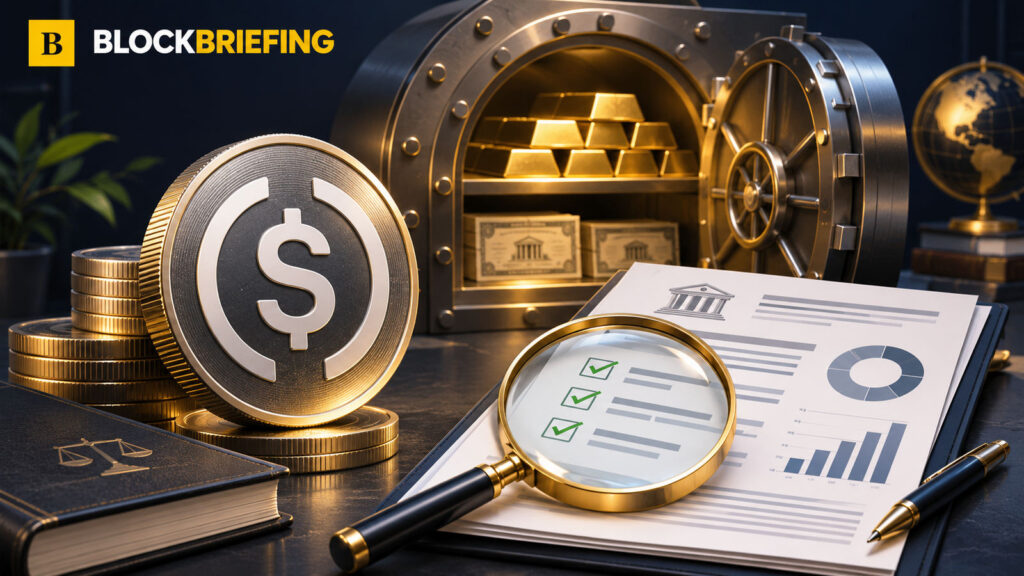
To verify stablecoin reserves, identify the issuer, locate its latest dated reserve statement, inspect the independent assurance scope, compare reserves with outstanding token liabilities, and review the legal right to redeem. A reserve balance is important evidence, but it does not guarantee every token holder can immediately receive cash.
The Circle USDC transparency portal provides an example of weekly reserve disclosures and monthly third-party assurance. Other tokens may use very different reporting, custody and collateral structures. Comparing them requires attention to dates, liabilities and the quality of the assets.
This guide explains a repeatable process for reading reserve reports, checking token supply and recognizing the risks that an attestation alone cannot resolve.
What Counts as a Stablecoin Reserve?
Fiat-referenced stablecoins aim to maintain a target value against a currency. An issuer may hold bank deposits, Treasury securities or other assets to support redemption of tokens. Those assets are often called reserves, but the contents and legal ownership can differ materially between issuers.
A stable market price is not itself proof of backing. Trading prices reflect exchange liquidity, arbitrage, redemption access and confidence. A brief deviation does not prove insolvency, but it can signal that further investigation is warranted.
Reserve assessment must consider both the quality of the reported assets and the rights of people holding the corresponding liabilities.
Identify the Issuer and Legal Entity
Start with the official issuer website, not with a token listing or an advertisement. Identify the actual legal entity responsible for issuing the stablecoin and any separate entities managing reserves, custody or redemption.
Read the terms and conditions to determine which customers can redeem directly. Some stablecoins permit only verified institutional customers to use primary redemption channels, leaving retail holders dependent on market makers or exchanges.
Check jurisdictions and whether the product changes across them. The same token name can appear in different legal structures, while wrapped copies issued by third parties may not carry the original issuer’s redemption rights.
Find the Latest Reserve Disclosure
Locate the issuer’s reserve transparency page and identify both the publication date and the as-of date. A report published in November can still describe balances as of the end of October. Treat the dates separately.
Record the reserve categories, aggregate reported value, token supply or redemption liability and any footnotes about valuation. If the issuer publishes weekly snapshots and monthly assurance, use the latest appropriate documents together instead of treating the older report as current.
The USDC transparency portal describes weekly reserve and mint/burn information and monthly third-party assurance. Its process is one example, not a universal industry standard.
An undated social-media screenshot or an exchange price chart is not a substitute for an issuer report.
Examine Asset Liquidity and Quality
Cash held at banks, short-dated government securities, commercial paper, loans and volatile crypto collateral pose different liquidity and credit risks. All assets are not equally easy to turn into cash during a wave of redemptions.
Look for maturity information, concentration in individual financial institutions, and whether assets are pledged or otherwise encumbered. A nominally valuable asset can be difficult to sell without loss at a particular time.
Even Treasury securities can involve settlement constraints or price changes. The important question is whether the reserve portfolio can support the obligations the issuer has promised under realistic stress conditions.
If an issuer does not clearly identify reserve categories, classify the uncertainty rather than assuming the backing is either sound or worthless.
Read the Attestation Report, Not Only the Summary
An attestation is an assurance engagement concerning defined assertions or subject matter. A stablecoin reserve attestation might assess whether certain identified assets were sufficient against a particular count of tokens outstanding at a specified observation date.
Read the report’s full title, criteria, scope, observation date and practitioner conclusion. Identify what management asserted and what the independent practitioner actually tested. Pay attention to qualifications and limitations.
Circle describes its monthly reserve assurance as prepared according to AICPA attestation standards. Such work can provide meaningful evidence about stated reserves, but the engagement’s scope still matters.
Do not assume that reserve assurance verifies every trading venue, blockchain contract, cybersecurity control or future business condition affecting the stablecoin.
Attestation Versus Financial Statement Audit
A financial-statement audit typically examines an entity’s statements under a specified accounting framework. A reserve attestation may focus more narrowly on balances, token liabilities or other defined representations.
Neither should be summarized as a universal guarantee that a company cannot fail. A rigorous attestation can support a narrow claim without examining all financial obligations, while an audited company may still suffer liquidity problems after the reporting period.
Compare the dates and scopes if both forms of reporting are available. A claim of being audited should be tied to the specific report and its subject instead of being used as a promotional label.
The most informative question is what the independent accountant concluded, not simply whether an accounting firm’s name appears on a webpage.
Calculate a Reserve Coverage Ratio
A basic coverage calculation divides eligible reserve value by the stated redeemable token liability. For illustration, a hypothetical issuer with $10.2 billion in eligible reserves against $10 billion in liabilities would show a reported coverage ratio of 102%.
That is an example, not a statement about any actual stablecoin. The real calculation depends on correct definitions. Determine whether tokens held in treasury count as outstanding, whether securities are valued at market value, and whether another obligation has a claim on reserves.
A ratio above 100% is useful information, but does not tell you whether all holders can redeem simultaneously, whether assets can settle quickly or whether rights are enforceable.
Always note the date of the numbers and avoid comparing a current liability total with an outdated reserve balance.
Check On-Chain Supply Across Networks
Use contract addresses published by the issuer to identify native tokens on each supported blockchain. Explorers can provide mint and burn events and balances, but cross-chain representations can make totals harder to interpret.
Some wrapped stablecoins represent claims on assets held by an intermediary bridge rather than direct issuer liabilities. Simply adding native supply to bridged supply can double count backing if the bridge holds the original tokens.
Look for official explanations of treasury balances, unreleased coins and supply adjustments. A market-data aggregator’s circulating-supply figure need not match a legally defined redemption liability.
If a token contract address is unclear, avoid interacting with it until verified. BlockBriefing’s Crypto Glossary can help clarify terminology.
Understand Redemption Eligibility
Reserves are designed to support redemption, but not every holder necessarily has a direct contractual claim to redeem. Check customer verification, minimum sizes, fees, banking deadlines and restrictions.
Retail holders may instead sell on secondary markets. Their realized price can depend on market-maker capital and exchange liquidity even when an issuer reports sufficient assets.
Determine whether redemption is for fiat currency, another asset or a different form of claim. Understand whether redemption can be paused or restricted under the terms.
An apparent reserve surplus should not be confused with a promise that any person anywhere can immediately receive one dollar for every token.
Custody and Insolvency Considerations
Reserve assets can be held by a bank, trustee, broker or custodian. Their identity and the legal arrangements governing accounts matter if an issuer or intermediary becomes insolvent.
Segregated accounting and bankruptcy-remoteness claims should be checked against governing documents rather than assumed from marketing language. Different jurisdictions can treat claims and asset ownership differently.
An attestation might provide evidence that assets existed on a given date without determining how creditor disputes would be resolved after an insolvency.
Readers should examine disclosures about the entities holding reserves and whether the issuer explains how the assets support token holders’ legal rights.
Risks Not Solved by Backing
Good reserve reporting does not eliminate smart-contract bugs, exchange outages, compromised wallets, network congestion or fraudulent intermediaries.
Stablecoins may also incorporate transaction freezing, sanctions controls or other compliance functions. These can affect specific addresses or users even when the issuer is fully backed.
Banking changes, regulatory developments and issuer governance decisions can arise after an assurance date. Stablecoin monitoring is therefore a continuing process rather than a one-time check.
Distinguish technical risk, liquidity risk, legal risk and collateral risk. They may interact, but each requires different evidence.
How to Compare Stablecoins
Use the same observation periods when possible. Compare reserve composition, assurance quality, issuer and custodian arrangements, redemption eligibility and public reporting frequency.
Cash-backed and crypto-collateralized models require different verification methods. Decentralized stablecoins may depend on liquidation rules, overcollateralization, governance and price oracles instead of a portfolio of fiat assets.
Do not make categorical rankings when key data is missing. Say which disclosures are unavailable and which important conclusions cannot be drawn.
Comparisons should also distinguish native tokens from bridged representations because their underlying claims can differ.
Warning Signs Requiring Further Research
Missing report dates, vague asset categories, unexplained gaps in reporting, inconsistent supply numbers and unclear redemption terms deserve closer inspection.
Additional concerns include heavy reliance on related-party loans, long-dated or hard-to-value assets, large custodial concentrations and unaddressed changes in banking relationships.
A market discount is a reason to ask questions, not proof that reserves are absent. Similarly, a reassuring report does not prove that every future event is manageable.
Where facts remain undisclosed, identify the uncertainty instead of manufacturing a confident conclusion.
Seven-Step Reserve Verification Checklist
First, confirm the native issuer and exact token contract. Second, retrieve the latest dated reserve statement. Third, read the independent accountant’s full report and scope.
Fourth, compare eligible assets with the correctly defined token liability. Fifth, evaluate the reserve mix and liquidity. Sixth, review customer eligibility and redemption rights. Seventh, cross-check supply across relevant networks and retain dated source links.
Revisit the analysis after major issuer announcements, changes in reserve structure or market disruptions. A dated evidence trail helps separate actual changes from rumor and recycled screenshots.
Use issuer information for factual statements and independent professional advice for material financial or legal decisions.
Frequently Asked Questions
Does an attestation prove a stablecoin is completely safe? No. It provides assurance only for the specified subject, conditions and dates.
Can a fully backed stablecoin trade below its peg? Yes. Liquidity, redemption eligibility and transaction delays can affect secondary-market prices.
Is proof of reserves enough? No. A reliable liability measure, asset-quality assessment, legal terms and custody arrangements are also necessary.
Does one explorer capture all liabilities? Not necessarily. Tokens may exist across multiple chains, through bridges or within issuer treasury accounts.
This article is provided for education. It is not an assessment of the solvency of any named issuer or a financial, accounting, legal or investment recommendation.