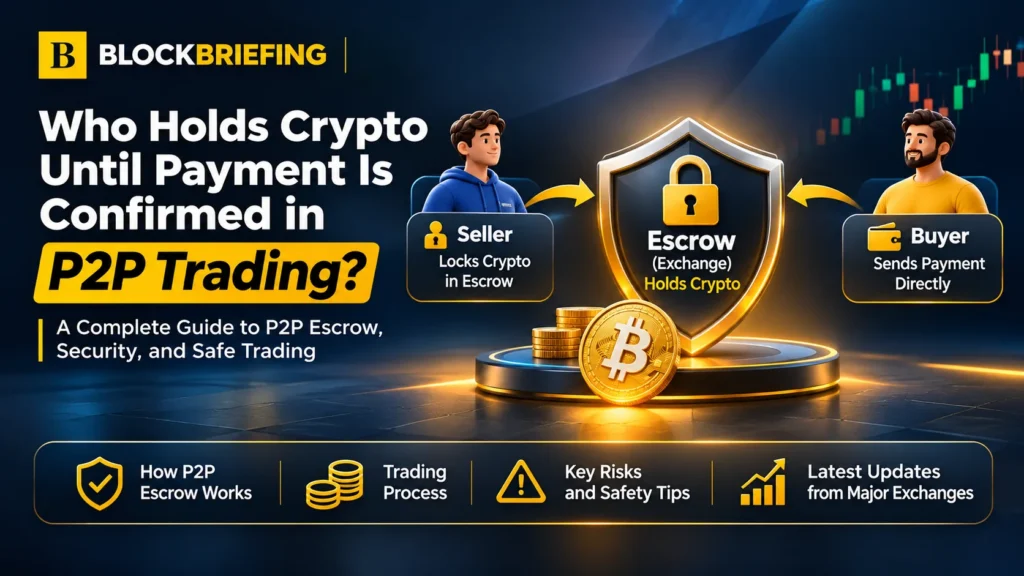
In P2P trading, who holds the crypto until payment is confirmed? On escrow-enabled exchanges such as Binance P2P, OKX and Bybit, the platform temporarily locks the seller’s cryptocurrency in escrow. The buyer sends money directly to the seller using the agreed payment method. Once the seller checks the receiving account and confirms the payment, the cryptocurrency is released to the buyer.
The important distinction is that escrow usually protects the crypto, not the bank transfer. A buyer marking an order as paid does not establish that money reached the seller. Likewise, a payment screenshot is not sufficient evidence that funds have cleared. The seller should verify the money independently before approving release.
Who Actually Holds Crypto During P2P Payment Confirmation
On a custodial P2P marketplace, the exchange operates the escrow mechanism. The seller provides the cryptocurrency for the order, but the platform restricts its movement while the trade is pending. Neither the buyer nor the seller should be able to withdraw or move those locked units through the ordinary trading interface until the order is completed, canceled under the rules, or resolved through a dispute.
For example, Binance’s P2P glossary says the seller’s assets are locked while an order is active. OKX’s escrow guidance, updated September 15, 2026, explicitly distinguishes the cryptocurrency it holds from the buyer’s off-platform cash payment.
Escrow does not necessarily mean the coins have been moved to a distinct, publicly visible blockchain address. On centralized platforms, it can be a restriction on balances maintained within the exchange’s custody and accounting systems. Users should rely on the authenticated order status and the platform’s terms, not assume an on-chain transfer will appear for every step.
How Escrow Works From Order to Crypto Release
- The trade is created. A buyer accepts a seller’s advertisement, including the amount, price, payment method and payment deadline.
- The seller’s crypto is locked. The platform reserves the cryptocurrency for that order so it cannot ordinarily be used elsewhere while the order is active.
- The buyer sends fiat. Payment goes through the specified bank or payment service directly to the seller. The exchange typically does not receive that fiat money.
- The buyer marks payment as sent. This is a notification to the seller, not proof of settlement.
- The seller verifies receipt. The seller checks the actual bank account or payment application for the correct amount, sender and payment status.
- The crypto is released. After confirmation, the seller authorizes release and the platform credits the buyer. If the parties disagree, the order may be handled through an appeal.
The Binance buying instructions describe this sequence and warn buyers not to cancel a paid order unless the payment has been refunded. The exchange’s support team can review an appeal if the seller does not release the cryptocurrency within the applicable process.
An Example Shows Where Your USDT Actually Sits
Suppose a seller offers 100 USDT market price and chart for a mutually agreed fiat payment of $100, purely as an illustration. When the buyer accepts the offer on an escrow-enabled exchange, 100 USDT is reserved from the seller’s available exchange balance. The buyer then sends $100 to the seller’s designated account.
While the payment is pending, the seller cannot freely trade or withdraw that locked 100 USDT, and the buyer does not yet control it. Once the seller sees the full $100 in the correct account, confirms receipt and approves release, the platform credits the 100 USDT to the buyer. If the buyer never sends the money, an order canceled under platform rules generally returns the crypto to the seller’s available balance.
This example assumes no platform, bank or payment-processing fees. Actual P2P prices, limits and fees differ by provider, account and currency. BlockBriefing’s crypto transaction fees guide explains why the visible exchange rate is not always the full cost of moving crypto.
Why Escrow Does Not Hold Your Bank Transfer
Most exchange-hosted P2P systems manage one side of the trade. The platform controls the crypto lock while the buyer transfers fiat through a separate payment rail. OKX says it cannot hold or freeze payments sent outside its platform. Bybit’s published P2P terms similarly describe off-platform fiat transfers between users as separate from its crypto escrow.
This matters because a payment notification, a pending transfer and money available in the receiving account are not necessarily the same thing. Depending on the payment method and local rules, a payment may also be recalled, disputed or reversed after it first appears. Escrow reduces the danger of a seller failing to deliver while an order is active, but it does not guarantee that fiat is final or that a counterparty is trustworthy.
What Binance OKX and Bybit Each Actually Hold
Binance P2P
Binance reserves the seller’s cryptocurrency for the trade. The seller checks the off-platform payment and confirms release. Binance’s guide updated June 26, 2026 says its P2P service supports more than 1,000 payment methods and over 100 fiat currencies, although individual options depend on location and eligibility. Those figures describe marketplace coverage, not the number of methods available to any one user.
OKX P2P
OKX says it holds the seller’s crypto once an order is created and releases it when the seller confirms payment. Its P2P instructions updated September 15, 2026 also explain that a buyer can open a dispute if the seller does not release crypto after payment. Cash transfers remain between users rather than in OKX escrow.
Bybit P2P
Bybit’s P2P terms provide for the seller’s assets to be locked in platform escrow pending the trade’s conditions or a dispute outcome. Its seller guide updated September 2, 2026 directs users to confirm actual receipt before selecting the release option. It also describes a possible 24-hour withdrawal restriction when its system identifies a transaction as risky. That is a risk-based control, not a universal hold on every order.
What Happens When Payment Confirmation Never Comes Through
If the buyer has not paid: The seller should not release the locked cryptocurrency. Where the payment deadline passes without a valid payment confirmation, the platform may cancel the order and return the reserved assets to the seller, subject to its current rules.
If the buyer has paid but the seller does not release: The buyer should preserve the bank transaction reference and proof of payment, remain in the in-app chat and open an official P2P appeal. The buyer should not cancel a paid order merely because the seller asks them to. Customer support may investigate and direct a release or other resolution according to the platform’s terms and the evidence.
If the buyer marks an order as paid without sending money: The seller should check the receiving account directly and use the dispute process rather than trusting the payment button or screenshot. A false payment claim does not entitle the buyer to crypto.
If money was sent to the wrong account or is pending: The bank or payment service may need to investigate. The exchange’s escrow team does not control the external payment rail and cannot promise to reverse a bank transfer. Keep transaction records and contact both official support channels when necessary.
Common P2P Scams That Escrow Cannot Fully Prevent
Escrow is a useful safeguard but it cannot protect traders who release crypto on the strength of forged screenshots, agree to transact outside the official order, or accept payment from a third party whose account details do not match the buyer.
- Fake payment evidence: A buyer sends a forged transfer receipt or altered banking screenshot and pressures the seller to release USDT.
- Chargeback or payment reversal: Money initially appears, but the payment method permits a later dispute or recovery attempt. The crypto may already have left escrow.
- Third-party account transfers: Payments arrive from an unrelated name, creating potential fraud, account-freeze or compliance problems. Follow the platform’s verified-name rules.
- Off-platform escrow impersonation: Someone directs the trader to an external website or messaging group claiming an exchange representative is holding the funds.
- Premature cancellation pressure: A buyer who has paid is pushed to cancel, or a seller is pressured to release before receiving usable funds.
OKX’s September 2026 scam guidance recommends staying within the official app, preserving evidence and reporting suspected fraud through the platform’s dispute process. These are particularly important because recovering released cryptocurrency may be difficult or impossible.
The wider fraud context is substantial but should not be confused with P2P-specific losses. In its 2026 crypto scams research, Chainalysis said it had identified at least $14 billion in on-chain scam receipts for 2025 and projected the figure could exceed $17 billion as more illicit addresses were identified. These are industrywide estimates, not a measurement of fraud on P2P escrow platforms.
Newer 2026 Platform Safeguards And Their Practical Limits
Recent platform documentation illustrates how P2P safety measures extend beyond simply locking coins. Binance’s June 2026 explanation emphasizes identity verification and exchange-managed escrow. OKX’s September 2026 guidance describes dispute procedures and the distinction between crypto custody and offline payment settlement.
Bybit’s help article updated October 29, 2026 describes security deposits for advertisers identified by its risk assessment. It lists 200 USDT for General Advertisers, 500 USDT for Verified Advertisers and 1,000 USDT for Block Advertisers when the deposit requirement applies. These deposits are separate from the crypto held against an individual buyer’s order. The page’s update date does not, by itself, establish when this requirement was originally introduced.
None of these measures amounts to a guarantee of reimbursement. Traders still need to verify bank deposits, review account-name requirements, use official dispute tools and understand that their chosen payment method may permit reversals.
How Buyers and Sellers Can Trade More Safely
Before the order: Review the counterparty’s trading history, completion rate, verification status, permitted payment methods and the exact agreed exchange rate. Read the marketplace terms and avoid offers that require a move to a different website or chat service.
When buying: Check that the seller’s payment details match the authorized order, use an eligible payment account in your own name, send the full agreed amount within the deadline and mark the order as paid only after the transfer has genuinely been made. Keep the receipt. If you have already paid, use the official appeal procedure rather than canceling at another person’s request.
When selling: Open your own bank or payment app to check the balance and transaction details. Do not use a screenshot, SMS or buyer’s claim as proof. Check the sender name and whether the funds are final under the payment method’s rules before releasing crypto. If anything looks inconsistent, seek official support.
After a completed P2P purchase, the asset may remain credited on the exchange. Moving it to a separate wallet is another transaction with its own custody and network considerations. For questions about an unrelated blockchain deposit that has not appeared in an exchange account, see BlockBriefing’s deposit troubleshooting guide.
Frequently Asked Questions About P2P Crypto Escrow Systems
Who holds the cryptocurrency until payment is confirmed?
On escrow-backed exchanges, the platform locks the seller’s crypto during the transaction. After the seller verifies payment and authorizes release, the buyer receives it. A dispute team may intervene where the rules permit.
Does the seller still own the crypto in escrow?
The crypto originates from the seller’s balance, but it is not freely transferable during the active order. Legal ownership and custody rights depend on the platform’s terms and applicable law, so an escrow lock should not be confused with a separate legal trust in every jurisdiction.
Can the buyer take the USDT before paying?
Not through the normal workflow of a functioning escrow-backed P2P order. The buyer can mark payment as sent, but that flag alone should not release the cryptocurrency. Fraud, technical failures and account compromise remain possible risks.
Does the exchange also hold the buyer’s money?
Usually not in bank-transfer-based exchange P2P trading. The buyer sends fiat directly to the seller through a separate bank or payment service. The precise design depends on the marketplace.
What if the seller refuses to release crypto?
Submit an appeal inside the exchange, attach genuine payment evidence and retain the complete order conversation. Do not send extra money or accept an unverified off-platform settlement demand.
Who holds crypto in P2P deals without escrow?
For a direct private arrangement without an escrow provider, the seller generally retains control until sending the crypto. In a smart-contract-based escrow design, the assets may instead be controlled by contract rules. Neither arrangement should be mistaken for the custodial escrow model used by major exchange marketplaces.
Is P2P escrow completely safe?
No. It reduces a specific delivery risk but does not remove payment reversals, forged evidence, phishing, exchange custody risks, disputes or local legal restrictions. Consult the provider’s terms and check the supported services in your jurisdiction.
Primary Sources and How We Verified These Rules
This guide was checked against primary platform documentation available on November 9, 2026: Binance P2P guide (updated June 26, 2026), Binance order and appeal instructions, OKX escrow explanation (updated September 15, 2026), Bybit seller procedures (updated September 2, 2026), Bybit advertiser security deposits (updated October 29, 2026), and Chainalysis scam estimates (January 13, 2026). Platform requirements can vary by region and may change.
Educational information only. This article is not financial or legal advice and does not guarantee safety, payment recovery or dispute outcomes. More educational material is available in BlockBriefing’s trading guides and crypto glossary.