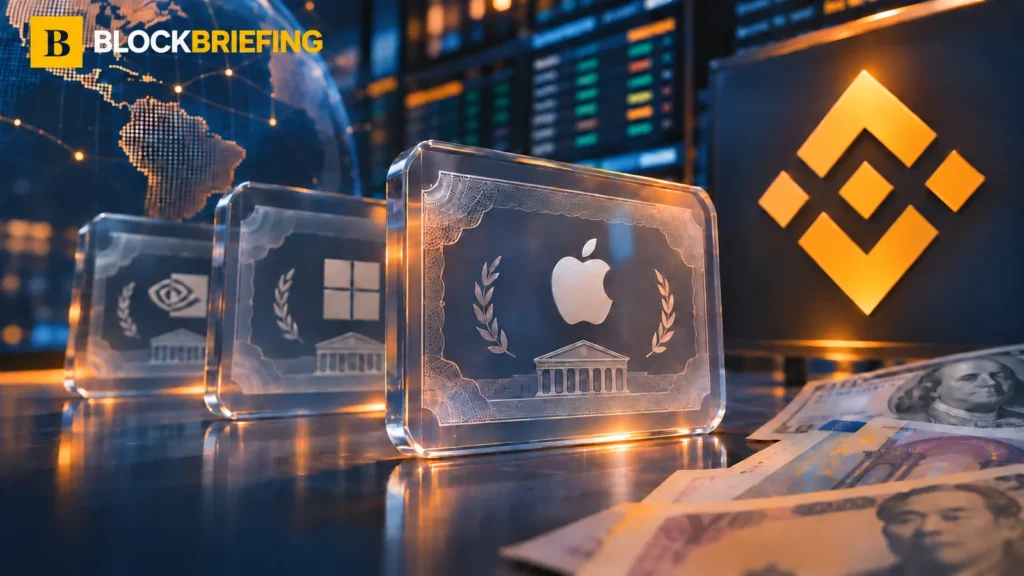
Binance announced on November 11 that its Convert and Buy/Sell services now support fiat purchases of bStocks using 49 currencies. Eligible customers can enter or exit the tokenized securities through supported fiat balances and payment methods, removing an intermediate conversion into cryptocurrency from the transaction flow.
The official announcement names card payments, Apple Pay and Google Pay among the potential entry routes. Actual options depend on residence, verification and product eligibility. A currency appearing in the list does not establish that every resident of the country associated with it can use the service.
Fiat Access Changes Funding Without Changing Ownership Rights
Binance describes bStocks as certificates issued by BTech Holdings Limited, a group affiliate, representing interests in underlying securities. It says the products are backed one-for-one by shares held through a regulated custodian, while explicitly stating that holders do not directly own shares in the underlying listed company.
That distinction matters when describing the announcement. Easier payment access changes how a customer funds a purchase. It does not, by itself, alter the legal claim attached to the certificate. Terms governing distributions, redemption, transfer restrictions and the issuer’s obligations still require separate review.
The payment update also sits alongside Binance’s handling of corporate actions. In a November 6 dividend notice covering IBM, Apple, Corning and Eli Lilly, the exchange said eligible distributions would be reinvested after taxes, fees and other deductions. Onchain holders receive the bStock dividend through a multiplier adjustment. The mechanism separates two parts of the product: how a customer pays for a certificate and how the issuer passes economic benefits from the underlying security to its holder.
Currency Support Remains Separate From Local Product Eligibility
The supported currency list includes the US dollar, euro, sterling, UAE dirham and Pakistani rupee. Binance’s notice also says the securities are offered through an approved prospectus in the Abu Dhabi Global Market and restricts access to eligible users and permitted jurisdictions. The notice’s regional wording should be checked against the applicable prospectus before drawing wider availability conclusions.
For a Pakistan-focused reader, the presence of PKR is therefore a payment-support detail rather than confirmation of local regulatory approval or unrestricted access. A reader should not have to infer residence eligibility from a currency code. The platform says available options are displayed according to the customer’s circumstances.
Tokenized Securities Require Attention To Their Legal Structure
The SEC’s investor explanation of tokenized securities distinguishes products that record an issuer’s own security onchain from arrangements involving third parties. Rights depend on the model used, making a product’s legal structure as important as the blockchain used to record it.
This is also why tokenized equity certificates and equity-linked futures should not be treated as interchangeable. One product may represent a contractual interest in held securities; another can provide price exposure through a margined derivatives position. Their funding, ownership and liquidation mechanics can differ substantially.
Binance’s earlier bStocks dividend timetable also includes temporary conversion and transfer suspensions around record dates. Expanded fiat access does not remove those corporate-action conditions. BlockBriefing’s crypto regulation tracker follows the wider rules affecting digital-asset services. For the new payment routes, the next useful disclosures would clarify eligibility by jurisdiction, conversion charges and any product-specific limits that apply when customers enter or exit their holdings.