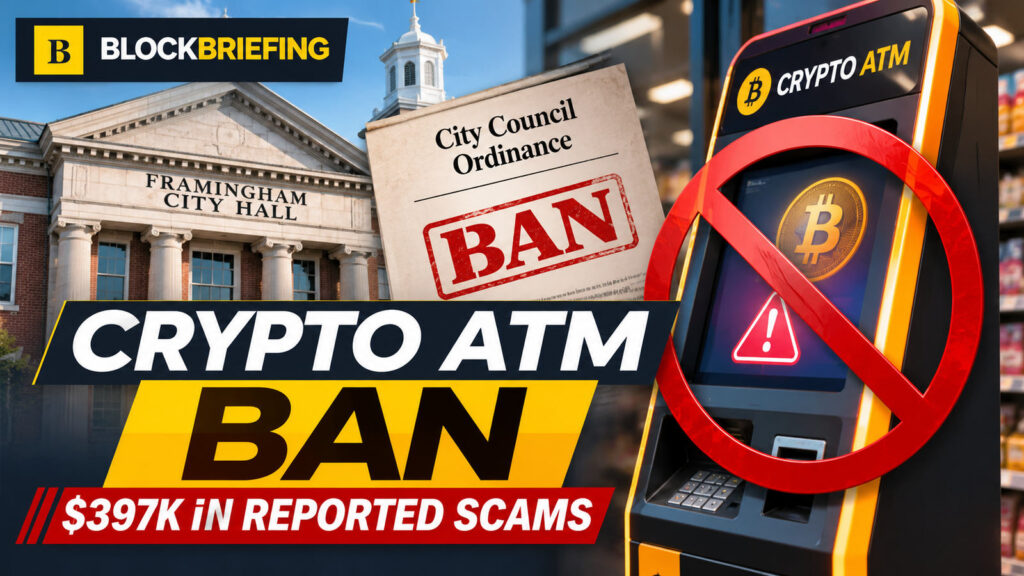
A Massachusetts city has voted to prohibit crypto ATM kiosks after officials linked 10 local scam reports to approximately $397,000 in losses, adding pressure on an industry facing growing scrutiny over fraud. Framingham’s City Council unanimously adopted the measure on November 5, 2026, following warnings that cash-to-cryptocurrency machines can be exploited by scammers who direct victims to send funds to unfamiliar wallets.
The decision places a local restriction on physical cryptocurrency kiosks, not on cryptocurrency ownership or trading generally. It also comes as the FBI reports that Americans filed more than 13,400 complaints involving cryptocurrency kiosks in 2025, with more than $388 million in associated losses.
Crypto ATM Ban Follows Ten Local Fraud Reports
Framingham councilors approved the crypto ATM prohibition after being told of 10 reported incidents since 2023 that together involved roughly $397,000 in losses. The figure was presented during the November 5 meeting and should be read as reported local cases, not as a count of all fraud in the city or an estimate of losses nationwide.
The City of Framingham’s public measures register records the earlier referral as Order 2026-102, introduced for consideration at the October 20 council meeting. The proposal moved through the council’s Rules, Ordinances and Ethics Subcommittee before the full-council vote. The city’s meeting archive also lists the November 5 session.
Framingham Council Unanimously Approves New Citywide Kiosk Restrictions
Councilor Mary Kate Feeney brought the proposal before the council. Middlesex District Attorney Marion Ryan and AARP representative Ryan Berard spoke in support during deliberations, while Councilor Michael Cannon raised concerns about a patchwork of municipal restrictions and the potential impact on people without conventional banking access. Cannon nevertheless supported the measure, and the ordinance was adopted unanimously.
The decision concerns the operation of cryptocurrency automated teller machines inside Framingham. Those machines typically let customers turn cash into  Bitcoin market price and chart or other digital assets and send the cryptocurrency to a destination wallet. The vote should not be interpreted as a statewide Massachusetts ban or as a prohibition on sending cryptocurrency through other channels.
The final ordinance’s implementation schedule, any grace period for existing machines, and its enforcement penalties have not been independently established from the city’s publicly accessible final text for this report. Operators should rely on the enacted municipal ordinance rather than assume that another Massachusetts town’s rules apply in Framingham.
How Crypto ATM Scams Move Cash Into Wallets
The fraud risk begins before the customer reaches the kiosk. According to the FBI’s May 2026 cryptocurrency kiosk advisory, criminals often contact victims by phone, email or social media, impersonate an authority or service provider, and instruct them to withdraw cash. A victim may then be told to visit a crypto ATM and scan a QR code that directs the purchased cryptocurrency to a wallet controlled by the criminal.
A July 31 filing announced by the US Attorney’s Office in Massachusetts shows how the pattern can work. Prosecutors alleged that a Ware resident was deceived by a fraudulent computer-support warning and then told to deposit money into a Bitcoin Depot kiosk at a Ludlow gas station. Federal authorities sought to recover approximately 47,461  USDT market price and chart connected to the alleged scheme after tracing and seizing assets. This was a separate Massachusetts case, not one of the 10 reported Framingham incidents.
Cash-to-crypto conversion is not inherently fraudulent. The problem is that once funds leave a kiosk for a scammer’s wallet, reversing the cryptocurrency transfer is generally not possible through the payment system, and asset recovery may require a separate investigation and legal process.
FBI Data Shows National Kiosk Losses Keep Rising
The scale of the issue extends beyond Framingham. FBI Internet Crime Complaint Center figures show more than 13,400 complaints and over $388 million in reported losses involving cryptocurrency kiosks during 2025. Complaints rose 23% from 2024, while losses increased 58%, according to the agency’s published analysis.
The same advisory said more than half of the reported complaints involved people over 50, whose associated losses exceeded $302 million. The FBI specifically cautions that a complaint may involve both kiosk transactions and other payments. Consequently, the full reported loss total cannot be attributed exclusively to money deposited at the machines.
Massachusetts Complaints Put Local Losses Into Wider Context
In the FBI’s state-level 2025 data, Massachusetts accounted for 296 complaints and about $6.83 million in adjusted losses involving cryptocurrency kiosks. Those statewide figures refer to a single reporting year and should not be directly added to Framingham’s approximately $397,000 across reports dating back to 2023.
The numbers underscore why local lawmakers have focused on the payment mechanism instead of only the underlying digital asset. At a retail kiosk, a customer can convert physical cash into a wallet transfer before a bank fraud team or trusted relative has an opportunity to intervene. Separate initiatives across the industry, including crypto scam-prevention programs, show that law enforcement and consumer education are becoming increasingly important parts of digital-asset adoption.
Earlier Attorney General Decision Supports Municipal Kiosk Bans
A Massachusetts legal precedent helps explain why some towns are pursuing their own restrictions. In a February 17, 2026 decision letter, the state attorney general approved South Hadley’s cryptocurrency ATM bylaw, concluding that its ban was within the town’s home-rule authority and did not conflict with state law or the constitution.
That decision concerned South Hadley, not Framingham. The former town’s 60-day removal provision and $300-per-day fine should therefore not be assumed to form part of Framingham’s adopted ordinance. The precedent is relevant because it shows a prior state-level legal review of a municipal prohibition, not because it determines the precise terms of this new ban.
Lawmakers Weigh Fraud Prevention Against Financial Access Concerns
The Framingham vote highlights a policy trade-off. Consumer advocates argue that eliminating unattended cash-conversion points removes a readily accessible tool in impersonation and emergency-payment scams. Critics of blanket bans question whether restrictions may also affect legitimate customers, including those who rely on cash or lack ready access to mainstream financial services.
Neither argument on its own establishes whether the measure will reduce the total amount of fraud. Scammers may try to move victims to different kiosks or payment methods outside the city. The outcome will depend on enforcement, consumer awareness, changes in reported incidents and whether operators can demonstrate effective fraud controls.
Authorities Urge Victims To Report Suspicious Crypto Payments
The FBI advises anyone pressured to use a crypto ATM by an unknown caller, supposed government official or technical-support representative to stop and independently verify the demand. It says government and law-enforcement agencies do not call people demanding payment through cryptocurrency kiosks.
People who believe they have been targeted should preserve the kiosk receipt, the destination wallet address, the transaction identifier and any associated messages. They can report the incident to local police and the FBI’s Internet Crime Complaint Center. Tracking the legal and regulatory response across jurisdictions is also part of BlockBriefing’s ongoing crypto regulation coverage.
For Framingham, the next measurable test is whether the city can translate its November 5 vote into reduced reported crypto ATM scam losses while clarifying implementation requirements for businesses currently hosting kiosks.