The proposed crypto loans system on the XRP market price and chart Ledger remains seven validator votes short of the support required to begin its mainnet activation process, according to network voting data reviewed by BlockBriefing on November 11, 2026.
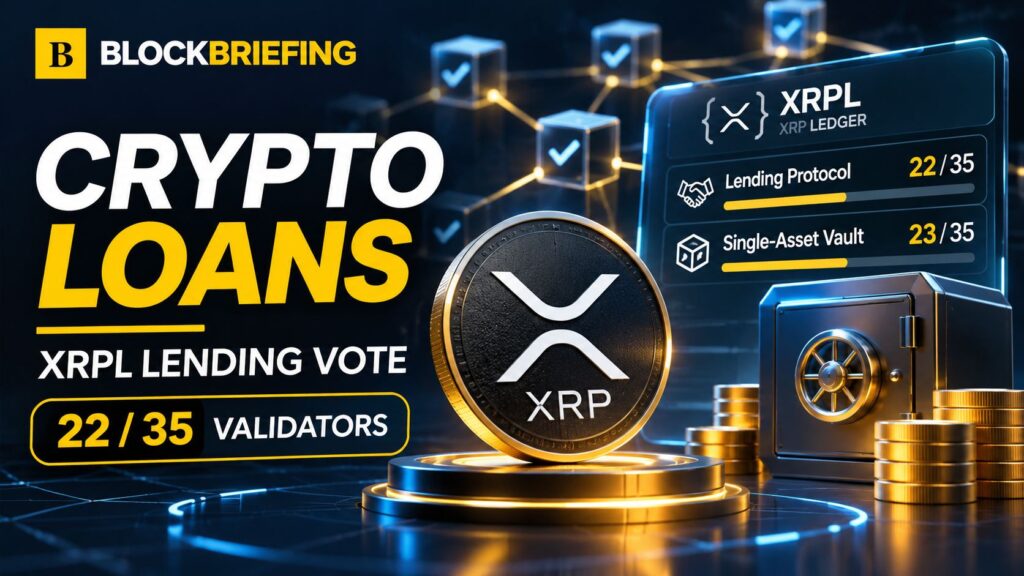
At the 16:06 UTC validator roll call, the live XRPL amendments dashboard, which records votes from its own XRP Ledger node, showed 22 of 35 trusted validators supporting LendingProtocol. The companion SingleAssetVault amendment had 23 votes, and LendingProtocolV1_1 also had 22. Each needs at least 29 of the 35 validators heard in that roll call to enter the required two-week approval period.
That leaves LendingProtocol seven votes short and SingleAssetVault six votes short. The dashboard reported no amendments in an active 14-day countdown. A comparison with its November 10 signed voting record found the same 22 LendingProtocol and 23 SingleAssetVault affirmative votes, meaning the latest data confirms an unresolved approval gap rather than a newly crossed threshold. The figures are a snapshot, not a final decision: validators may change their votes, and the trusted validator list can change.
New Validator Data Shows Where Lending Votes Stand
Voting support amounted to approximately 62.9% for LendingProtocol and 65.7% for SingleAssetVault at the time of the check. The XRP Ledger’s rule is stricter than simply reaching 80%: an amendment must receive more than 80% support for two consecutive weeks before it is enabled, as explained in the network’s official amendment documentation.
With 35 validators participating, 28 affirmative votes would equal exactly 80%, which is insufficient. The minimum is 29. If either proposal crosses that line, the two-week clock begins; if support falls back to 80% or below, the countdown resets. The voting status does not establish an activation date, and neither proposal is presently live on mainnet.
The three amendments cover related but different elements of the planned infrastructure. LendingProtocol would add loan origination and servicing; SingleAssetVault would provide the pooled funds; and the V1.1 amendment would add closed-ended vaults and accounting refinements. XRPL’s September 2026 server release notes describe the V1.1 changes, but inclusion in software does not itself enable a feature on the live network.
Why Two Amendments Must Pass Before Lending Begins
Unlike a lending application operating entirely through separate smart contracts, the proposed arrangement would introduce lending primitives into the XRP Ledger’s protocol rules. The vault and lending components depend on each other: a vault holds the loanable assets, while the lending component provides the records and transactions used to manage individual loans.
Under XRPL’s technical documentation, depositors contribute assets to a single-asset pool and receive corresponding vault shares. A loan broker establishes terms with a borrower, including principal, repayments, interest and applicable fees. Borrowers receive assets from the pool and repay according to the agreed schedule, with the ledger tracking the resulting changes.
The system is designed for fixed-term credit, not an instant, unrestricted borrowing facility for every XRP holder. The current specification describes loans without on-chain collateral requirements, while credit underwriting and assessments of borrower quality remain off-chain.
How XRPL Crypto Loans Would Actually Operate Onchain
Three groups would interact with the planned facility: depositors supplying loanable assets, brokers originating and administering credit, and borrowers receiving funds. A vault is limited to one underlying asset type but can pool contributions from multiple depositors. XRPL documentation identifies native XRP, issued tokens and multipurpose tokens as potential asset types in the broader vault framework.
The workflow could also support institutional stablecoin credit where permitted by the relevant asset issuer. The network’s institutional credit guide describes the possible use of credentials and permissioned domains to limit access based on specified eligibility checks. These are design capabilities, not evidence that banks have already originated live loans using the proposed protocol.
For investors following XRP, there is an important distinction between a network’s ability to support loans and guaranteed demand for its native token. A facility denominated in an issued dollar token would not necessarily require borrowers to take principal in XRP. Separate market activity also matters: BlockBriefing recently reported on XRP’s price and futures positioning, which should not be confused with adoption of a lending amendment.
Credit Risk Remains Despite Onchain Loan Settlement Features
The absence of mandatory on-chain collateral changes the risk profile. In conventional overcollateralized DeFi loans, collateral values and liquidation rules can be monitored by contracts. XRPL’s current native lending design instead depends on a broker’s assessment of a borrower’s ability to repay and does not include automatic on-chain collateral liquidation.
Its optional first-loss capital feature allows brokers to put their own capital at risk to absorb part of a default before depositors bear additional losses. However, the official protocol explanation expressly cautions that first-loss protection does not eliminate credit risk. A borrower could still miss a scheduled payment, and a vault’s funds can be impaired if recoveries do not cover the debt.
Issuer controls are another consideration for loans involving issued assets. The documentation says issuers may be able to freeze or claw back certain tokens subject to their applicable rules, which can affect a borrower’s ability to repay. Those mechanisms differ from XRP itself and warrant examination before any platform markets the feature as an unrestricted lending product.
The wider crypto loans industry already includes different models. For example, BlockBriefing recently covered Bitcoin-backed lending infrastructure, where collateral management is central to the product. XRPL’s proposed credit model is not interchangeable with those services.
Institutional Lenders Could Use Vaults And Credentials Together
The combination of pooled assets, configurable repayment schedules and optional permissioned access could appeal to organizations seeking blockchain settlement without relying exclusively on anonymous, collateral-based borrowing. Nevertheless, operational responsibilities remain outside the ledger: verifying borrower identities, assessing financial statements, setting credit policies and pursuing recoveries would still require accountable participants.
The additional closed-ended vault design outlined in the official XRPL 3.4.0 release notes separates subscription, investment and redemption phases. It also provides cash-basis accounting, under which interest is recognized when payments are actually made rather than simply accrued. These details matter to prospective lending operators considering cash-flow recognition and redemption schedules.
BlockBriefing has also reported on RLUSD’s expansion across trading and custody venues. That development gives broader stablecoin context, but it is not confirmation that RLUSD-backed XRPL loans are live under the pending amendments.
What Validators And Borrowers Need To Watch Next
The immediate milestone is straightforward: LendingProtocol must gain at least seven additional affirmative validator votes, while SingleAssetVault requires six, assuming the observed 35-validator count remains unchanged. The V1.1 amendment separately needs seven. Reaching that threshold would start a 14-day period, not produce instant mainnet activation.
Beyond the vote, prospective lenders should review how brokers will underwrite loans, what first-loss funds are actually committed, who can deposit or borrow, what happens in default, and whether the relevant issuer imposes restrictions. No verified loan volume or lending yield should be inferred from governance support alone.
Reporting methodology: BlockBriefing checked the node-derived validator roll call for November 11, 2026 at 16:06 UTC against XRP Ledger’s primary amendment, lending-protocol and institutional-credit documentation. Vote totals may change after publication.