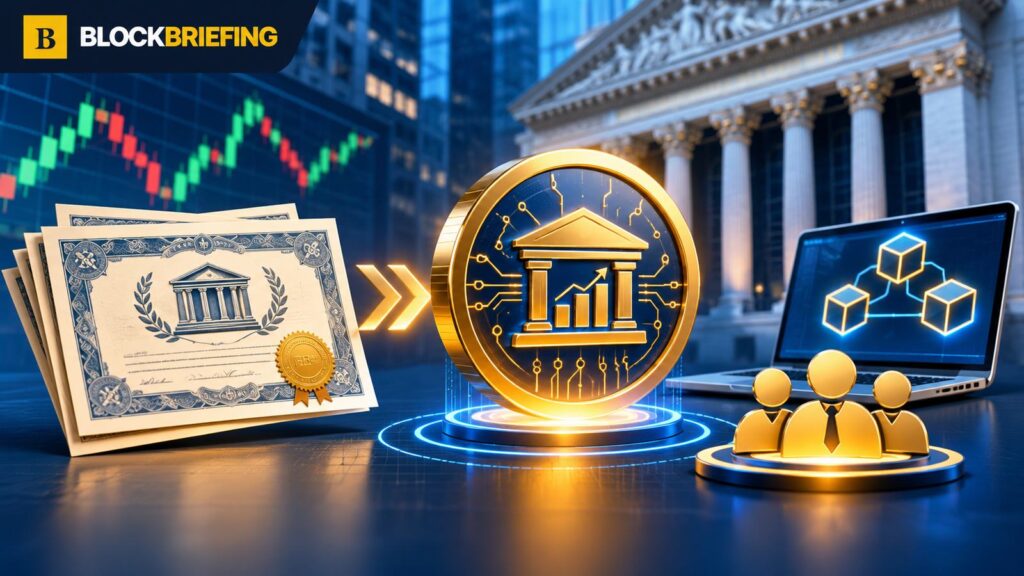
Tokenized stocks are blockchain-based instruments designed to represent shares, their economic performance or a legal claim linked to traditional securities. Their names can resemble ordinary stock tickers, but the rights held by the token buyer depend on the issuer, legal structure and product documentation.
Not all tokenized stocks make the holder a registered shareholder. Some structures record ownership of actual securities through a blockchain-enabled register; others issue third-party tracker instruments that provide market exposure without voting rights. This distinction is especially important as exchanges expand tokenized-equity offerings.
How Blockchain Tokens Can Represent Traditional Share Exposure
In an issuer-sponsored model, a company or its agent can use distributed-ledger records as part of the authoritative ownership record. A transaction involving the token may then represent a transfer of the underlying security. In a third-party model, an intermediary may acquire and hold ordinary shares before issuing a separate token or certificate linked to their value.
The US SEC’s January 2026 statement on tokenized securities distinguishes these structures and emphasizes that the rights of token holders vary. A blockchain format does not remove ordinary securities-law questions about issuance, ownership and transfer.
Why Economic Exposure Does Not Guarantee Shareholder Rights
Consider the xStocks product family. The issuer’s product FAQ describes each xStock as a tracker certificate intended to provide economic exposure to a referenced share. It says holders do not receive ordinary shareholder voting rights. The corresponding equities are held in segregated custody arrangements described by the provider.
Kraken’s product disclosure likewise says xStocks do not carry direct cash-dividend entitlements or voting rights, although economic dividend effects can be reflected through rebasing. The meaning of backing and the token holder’s recovery rights should still be checked in the legally binding prospectus.
How Dividends Trading Hours And Redemptions Actually Work
Traditional shareholders may receive cash dividends and exercise governance rights, subject to the share class and local law. A tracker token may instead increase its token balance, reflect dividend value in pricing, or follow another formula in its documentation. These outcomes are not interchangeable.
Although some on-chain tokens can trade around the clock, the referenced stock exchange may be closed. Prices outside normal market hours can deviate because of thinner liquidity, wider spreads and the absence of active reference-market trading. Direct redemption may also be restricted to eligible participants, with retail holders dependent on secondary liquidity.
Which Risks Investors Should Check Before Buying Tokens
Tokenized stocks involve more than equity price risk. Investors must evaluate issuer solvency, custody of backing shares, market-maker arrangements, token-contract security, blockchain outages, legal enforceability, corporate actions and jurisdictional limitations.
Access is not universal. Kraken says its xStocks product is restricted in certain countries, including the United States. The availability of a token on an open blockchain does not override local securities laws or platform eligibility rules.
Why US Rules Depend On Each Product Structure
The SEC’s September 2026 conditional innovation exemption addresses specific tokenized securities trading structures, not every product marketed as tokenized stock. Investors should therefore ask whether a given token represents direct share ownership, a debt claim, a derivative or a different financial instrument.
Understanding The Three Main Tokenized Security Ownership Models
The label “tokenized stock” describes the format, not a single uniform legal instrument. The SEC’s tokenized-securities investor guide distinguishes issuer-sponsored instruments, custodial entitlements and synthetic securities. In an issuer-sponsored arrangement, the issuer or its appointed agent uses a blockchain-linked record for shares. A custodial arrangement may represent rights to securities held through an intermediary. In a synthetic arrangement, a separate issuer promises an economic payoff tied to the stock price without making token holders shareholders in that company.
These structures can have very different voting rights, dividend treatment, legal claims and insolvency outcomes. The SEC’s January 2026 statement on tokenized securities explains why legal structure must be understood before relying on a blockchain token’s name.
Comparing Direct Share Ownership With Synthetic Token Exposure
| Feature | Direct company share | Equity-linked tracker token |
|---|---|---|
| Underlying interest | Equity in issuing company | Contractual exposure defined by token terms |
| Voting | Normally depends on share class | Often unavailable |
| Dividends | Paid according to shareholder entitlement | May be reflected in token economics |
| Custody | Broker/transfer agent/custodian arrangements | Token issuer, collateral custodian and blockchain |
| Additional exposure | Issuer and securities market | Token issuer, smart contract, redemption and liquidity |
The table describes common differences, not a guarantee about every product. Some custody-backed tokenized entitlements may provide rights closer to those held through a traditional securities intermediary. Always read the legally binding prospectus and terms rather than treating a comparison table as a substitute.
How Tokenized Stocks Handle Dividends Voting And Splits
Dividends are especially easy to misunderstand. Ordinary shares may pay cash dividends directly to eligible registered holders or through their broker. A tracker product can instead adjust its token quantity or other economic calculations. For example, the xStocks issuer FAQ describes a tracker certificate backed by underlying securities and explicitly says holders do not obtain ordinary voting rights. Kraken’s xStocks FAQ explains that economic dividend benefits may be reflected through a rebasing mechanism rather than cash payments to a registered shareholder.
Stock splits, mergers, spin-offs, delistings and rights issues create further questions. An investor should verify the issuer’s corporate-action policy: will token quantities change, will the instrument be redeemed, will a new token be issued, and what happens if the underlying stock stops trading?
Why Twenty Four Hour Trading Changes Liquidity Risks
Some tokenized equities can trade on a blockchain when the underlying stock exchange is closed, but continuous technical transferability does not mean continuous deep liquidity. The underlying share’s last official price can become stale while token market makers widen spreads. A person placing an on-chain trade at night may receive substantially worse execution than expected from the last stock quote.
Market price, quoted midpoint, transaction price and the issuer’s redemption reference are different values. Before trading, consider depth, spreads, network fees, the market-maker model and whether the token actually can be redeemed by an ordinary holder. Read our guide to slippage and price impact for a worked explanation of why an apparent quote may not equal execution cost.
Checking The Issuer Custodian And Redemption Legal Terms
A useful due-diligence review starts with five entities: the company whose share is referenced, the token issuer, the underlying securities custodian, the blockchain contract operator and the exchange or broker providing the market. They may be different organizations. Confirm whether underlying shares are held 1:1 and how that claim is independently verified. Public proof of reserves, where available, should be read alongside liabilities, reconciliation periods and legal documents.
Ask whether you have a direct ownership interest, a security entitlement, a debt claim or a derivative. Does the token issuer allow redemption for the referenced share, only for cash, or only to eligible institutions? Which laws apply if an intermediary fails? Review geographic restrictions: technical access to a token does not establish that buying it is legal or permitted in every country. For a related approach to assessing backing statements, see how to read backing and reserve disclosures; stablecoins are different instruments, but the evidence-checking principle is useful.
Working Through A Simple Tokenized Equity Investment Example
Consider a purely hypothetical tracker that costs $100 per token before fees. If the referenced share increases 10% and the tracker follows that change perfectly, its indicative value becomes $110. If it instead decreases 10%, indicative value becomes $90. Actual proceeds may differ because of spread, management charges, issuer-specific adjustments, currency conversion and liquidity. If an investor purchases half a token for an effective $51 after costs, a later quote of $55 for that half-token implies only $4 gross gain before any exit costs—not the $5 suggested by a fee-free calculation.
This example illustrates economic exposure, not a forecast or claim about any actual instrument. Token holders also need to know what happens during chain outages or contract pauses, when exchange trading and on-chain transferability can diverge.
How To Verify Real Stock Backing And Reserves
- Identify the exact token issuer and legal product name, not just a familiar stock ticker.
- Find the issuer’s current prospectus, contract terms and applicable regulator disclosures.
- Determine whether the token represents equity, an entitlement, a note or synthetic exposure.
- Check who safeguards underlying shares, how segregation works and what reporting supports backing claims.
- Verify the official blockchain contract and supported network. Use our contract verification guide.
- Read redemption eligibility, settlement, fees, corporate actions and geographic restrictions.
- Review secondary-market liquidity independently of promotional statements about 24/7 access.
Frequently Asked Questions About Tokenized Stocks And Ownership
Do tokenized shares always carry voting rights?
No. The answer depends on whether a token represents an actual equity interest or a separate instrument linked to the share price.
Are all tokenized stocks backed one-to-one?
No. Certain issuers claim and document backing; other structures can be synthetic or collateralized differently. Review product-specific evidence.
Does a blockchain make stock purchases risk-free?
No. Prices can fall, custodians or issuers can fail, contracts can have bugs and illiquid markets can produce poor execution.
Can US investors trade every tokenized equity?
No. Securities rules and platform availability are jurisdiction-specific. Some products exclude US persons entirely; always check the current offering terms.
For a current market example, see BlockBriefing’s report on xStocks’ expansion into European equities. Tokenized stocks may change market access and settlement technology, but careful reading of the issuer’s terms remains essential to understanding what the investor actually owns.