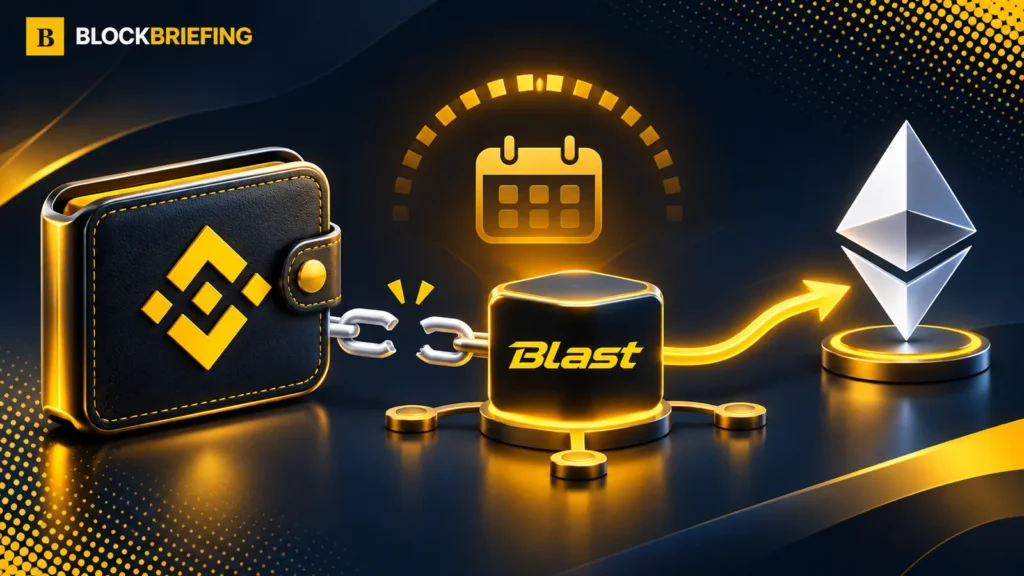
Binance Wallet will discontinue support for Blast on November 30, leaving affected users unable to view, send or receive Blast assets through the wallet’s interface after the cutoff.
In its November 12 announcement, Binance set the deadline at 10:00 UTC, or 3:00 p.m. Pakistan time. It directed holders to Blast’s official recovery website and said other supported blockchains are unaffected.
Wallet support cutoff differs from the network shutdown
The new development is Binance Wallet’s support deadline. It should be distinguished from Blast’s earlier network shutdown and the separate recovery arrangements for assets previously held on the network.
Binance says the change affects asset display and management inside its wallet. It also warns that displayed balances may not be accurate following the shutdown. A number shown in the interface should therefore not be treated as independent confirmation of the amount recoverable.
The company recommends managing affected assets before its cutoff and says claims may continue through the official site while that site remains operational. The November 30 wallet deadline is therefore not presented as the final date of the separate recovery service.
Official recovery portal identifies supported balances and withdrawals
The Blast Fund Recovery portal says holders of ETH market price and chart, WETH or USDB on Blast, including unfinished withdrawals to Ethereum, can check their recoverable balances. Claims are made on Ethereum mainnet through recovery contracts.
The portal allows an address lookup, including for a wallet authorized to claim for another account. It says unfinished withdrawals are included automatically. This is a claim process for supported balances, not evidence that ordinary transactions on the former network continue.
Blast also provides a separate explanation for users of its mobile app, whose address does not exist on Ethereum in the same way. Its instructions stress that a seed phrase belongs only inside a wallet application and must never be entered into a website.
Two different interfaces create different questions for holders
A wallet interface and a network recovery contract serve different functions. Losing access to an asset display within one application does not by itself establish that the underlying recovery entitlement has disappeared. Equally, seeing a balance in an application does not establish that it can still be transferred through the old network.
That distinction is relevant to BlockBriefing’s explanation of crypto custody and private keys. Its guide to network-related recovery risks similarly explains why the specific chain and receiving environment matter when investigating an asset-access problem.
The practical deadline in today’s notice concerns Binance Wallet functionality. Recovery eligibility and the amount available need to be checked against Blast’s own portal. Neither announcement supports a general claim that every token formerly displayed on Blast is covered by the same recovery arrangement.
Binance published the notice at 02:00 UTC on November 12, equivalent to 7:00 a.m. Pakistan time.
Users reviewing a claim should also distinguish an official portal from a message merely using a project’s name. Recovery situations create a reason to verify the destination carefully, particularly when an instruction asks for wallet access or a transaction signature.