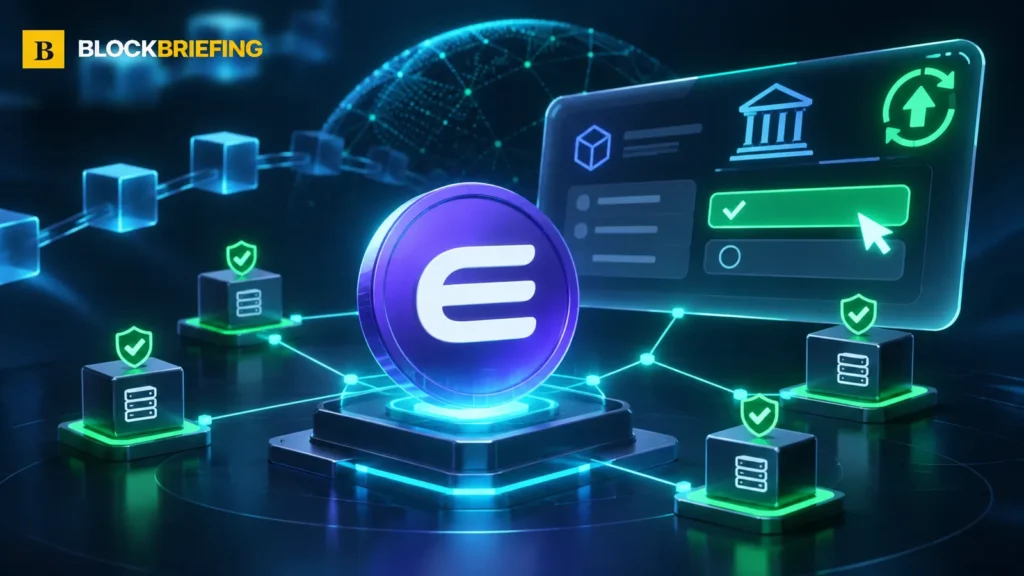
Enjin has introduced a revised governance experience aimed at making proposals, votes and treasury requests easier for community members to review. The November 12 update concerns how participants interact with on-chain governance and arrives alongside a separate series of network changes under the Fort Canning upgrade.
The Enjin Governance portal shows referenda and related proposal information, while the project’s Fort Canning technical changelog gives the technical timetable. These records should not be conflated: a new interface does not by itself alter voting rights, and the planned Matrixchain upgrade remains subject to its referendum.
Governance portal makes proposals and spending easier to follow
Treasury funding requests use proposals recorded on-chain. Enjin explains that the spend_local call can be wrapped in a submitted referendum, with deposits and track-specific requirements. Approved requests are paid according to the treasury’s spending cycle and available balance. A public treasury page can make those rules easier to follow, but it does not guarantee that every proposal succeeds or is funded immediately.
At the protocol level, Enjin is also preparing a distinct governance transition. Its official Fort Canning changelog says the Relaychain upgrade was approved on October 28 and activated on November 9. A Matrixchain referendum runs from November 10 through 13, with an upgrade targeted for November 16 if the vote passes. That second date must not be reported as unconditional.
Fort Canning brings separate changes to blockchain voting
The Matrixchain change would replace older Democracy, Council and Technical Committee pallets with OpenGov components, including referenda, conviction voting, origins, whitelisting and the Fellowship. The official specification identifies 15 voting tracks. These changes affect the decision-making mechanism itself, going beyond what an interface redesign can accomplish.
Participation carries financial and technical conditions. Enjin’s current parameters include a 1,000 ENJ submission deposit and significantly larger decision deposits for some administrative tracks. Conviction voting can increase a vote’s weight by locking tokens for longer. Such rules matter because an interface offering open proposal creation does not mean proposals can be submitted without cost.
Deposits and approval tracks still govern participation
The upcoming Matrixchain upgrade also requires technical preparation by node operators and integrators. Transaction versions change, with old signatures becoming invalid after enactment. Marketplace activity may be interrupted temporarily while listings migrate. These operational details come from the network upgrade documentation, not the Governance 2.0 interface description.
The practical measure of success will be whether people can understand the choices before them, check treasury spending and verify completed decisions. The underlying blockchain records offer stronger evidence than a screenshot of a proposal dashboard. Governance remains a combination of software rules, active participation and enforceable execution.
According to Enjin’s upgrade notes, the Relaychain changes activated November 9, while a Matrixchain vote continues through November 13. The proposed November 16 Matrixchain activation depends on approval. Referring to that vote as an already completed upgrade would misstate the network’s schedule.
The practical issue for token holders is how on-chain proposals become binding decisions. BlockBriefing’s introduction to blockchain and crypto networks explains the underlying distinction between an application interface and its protocol. Its coverage of Injective’s network upgrade provides a separate example of why activation dates and operational changes must be reported precisely.