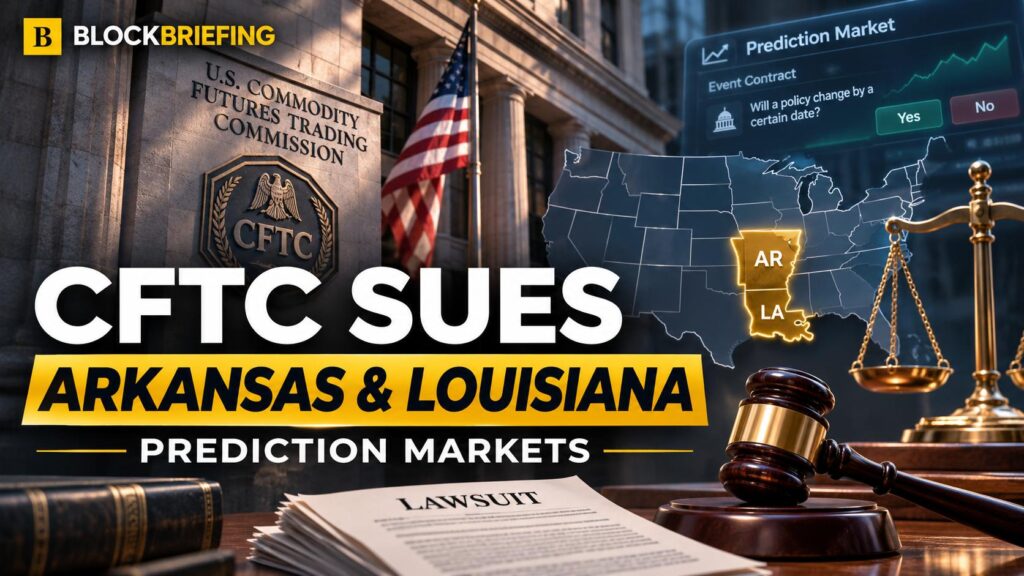
The U.S. Commodity Futures Trading Commission has filed lawsuits against Arkansas and Louisiana to challenge state attempts to restrict prediction-market contracts traded through federally regulated derivatives platforms. The cases raise a wider question about the division of authority between federal market regulators and state governments.
In its Arkansas announcement and a separate Louisiana release, the CFTC said the actions were filed on November 13. The agency argues that the Commodity Exchange Act gives it exclusive authority over the relevant federally regulated derivatives markets. The filings do not mean a court has finally decided that dispute.
CFTC Challenges Arkansas Enforcement Against Kalshi Prediction Contracts
In Arkansas, the regulator says state authorities are pursuing civil enforcement against Kalshi, a CFTC-designated contract market. The federal agency alleges the state is trying to stop event-contract trading and could impose civil penalties amounting to hundreds of millions of dollars on federally registered exchanges.
Event contracts let traders take positions on specified future outcomes, which can include developments in business, economic data, politics or sports. Their regulation is contentious because some resemble financial derivatives while others may raise questions under state gambling and consumer-protection laws.
The CFTC says Arkansas is interfering with the operation of exchanges registered under federal law. That is the regulator’s legal position, not a judicial finding. The question for the courts is whether and to what extent federal derivatives law prevents the state from applying its own rules to these contracts.
Louisiana Court Order Affects More Than Thirty Companies
The Louisiana lawsuit followed a state-court order that, according to the CFTC, halted operations involving more than 30 companies connected to CFTC-regulated derivatives activity. The agency said the order was issued without advance notice to the affected defendants or an opportunity for them to be heard.
The federal complaint seeks to stop the state from blocking event contracts offered through registered designated contract markets, futures commission merchants and derivatives clearing organizations. Those categories represent different parts of the regulated derivatives system, from exchanges to brokers and clearing firms.
The CFTC says it is asking federal judges to preserve existing market operations while jurisdictional questions are considered. A lawsuit is a request for relief, however, and does not itself establish that the regulator’s interpretation will prevail.
Federal And State Authorities Dispute Prediction Market Oversight
The agency characterized Arkansas as the eleventh state it had sued to defend federal authority and Louisiana as the twelfth. These counts come directly from the two CFTC releases and describe the regulator’s litigation campaign, not a tally of resolved cases.
CFTC Chairman Michael S. Selig argues that federally registered exchanges operate under the Commodity Exchange Act and that state efforts to halt trading could interfere with national derivatives regulation. The agency has also filed friend-of-the-court briefs in federal appeals courts and a state supreme court.
The competing state interests may include regulation of wagering, public protection and conduct within state borders. The cited agency releases provide the CFTC’s position; they do not give a complete account of the states’ responses. Those responses and the court filings should be reviewed before drawing conclusions about the merits.
Kalshi And Crypto Platforms Face Wider Regulatory Uncertainty
Although prediction-market contracts are not necessarily cryptocurrencies, the dispute matters to digital-asset companies that offer event trading or operate regulated derivatives platforms. Market structure, exchange status and the scope of federal oversight can affect which products can be offered across the United States.
BlockBriefing previously covered the CFTC’s challenge to Utah restrictions on prediction markets. The new lawsuits show that the jurisdictional conflict has expanded, but they should not be confused with new legislation or an immediate nationwide rule change.
The next meaningful developments would be court orders addressing interim relief, filings explaining the states’ legal arguments, and eventual rulings on federal preemption. Until then, the regulator’s position remains contested and the outcome uncertain.