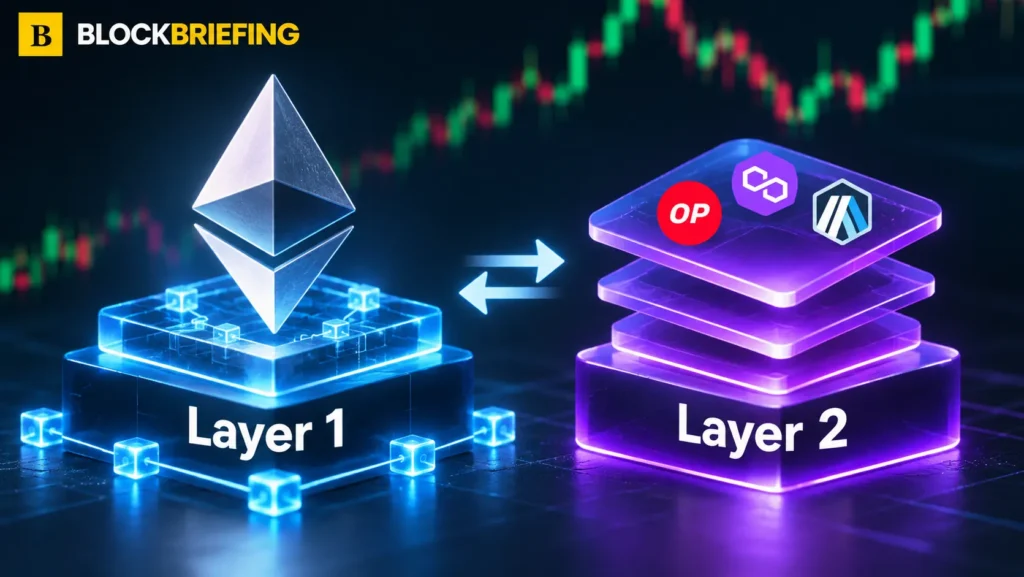
Layer 1 versus Layer 2 describes the difference between a base blockchain and an additional system built to help it process activity. Ethereum and Bitcoin are examples of Layer 1 networks. An Ethereum Layer 2 can execute transactions in a separate environment and use Ethereum for elements of settlement, data availability or security. Not every chain marketed as a Layer 2 has the same protections.
Ethereum’s official Layer 2 introduction explains that these networks aim to scale transaction activity without requiring all execution on the underlying mainnet. The technical details, including withdrawal rules and how transactions are proved, vary substantially across systems.
What is a Layer 1 blockchain?
A Layer 1, or L1, is an underlying blockchain with its own consensus and transaction validation system. Participants use the network’s native rules to submit transactions and determine which state changes become final. Ethereum mainnet is an L1 that hosts smart contracts; Bitcoin is an L1 designed around its own proof-of-work rules and transaction model.
Demand for limited block space can increase transaction fees. A base chain can change its capacity through upgrades, but these upgrades must be assessed against decentralization, validator requirements and security. Layer 2 networks are one way to increase activity without placing every operation directly on the base chain.
What is a Layer 2 blockchain?
A Layer 2, or L2, is a scaling system that derives defined security properties from its underlying Layer 1. On Ethereum, rollups process transactions separately and publish data or commitments to mainnet according to their architecture. They can bundle many user transactions so that some underlying costs are shared.
The phrase does not imply that all L2s are interchangeable. An L2 may depend on a sequencer, proof system, governance keys or upgrade authorities. Users should look beyond a low advertised fee and ask how a disputed transaction can be verified and what happens if the operator is unavailable.
How do optimistic and zero-knowledge rollups differ?
Optimistic rollups generally assume state updates are valid unless challenged, with fraud-proof or dispute mechanisms intended to address invalid transitions. Withdrawals to the base chain may involve waiting periods depending on the protocol and route used.
Zero-knowledge rollups use validity proofs to demonstrate that specified computations follow the system’s rules. The construction and verification of those proofs have their own costs and assumptions. Neither label alone certifies that an individual network is fully decentralized or free from operational risk.
Ethereum’s scaling documentation describes how both categories aim to use the base layer while moving execution elsewhere.
Is every sidechain a Layer 2?
No. A sidechain can be interoperable with Ethereum while relying on a separate validator set and its own security guarantees. Calling two networks ‘Ethereum-compatible’ does not prove that both inherit Ethereum consensus security. Bridges, external custodians and cross-chain messaging introduce additional trust assumptions.
For more on movement between different chains and asset representations, read BlockBriefing’s crypto bridge explainer.
Why do transaction fees differ between L1 and L2?
A Layer 1 transaction uses the base chain’s resources and competes directly for its limited block space. A Layer 2 can process many actions off the base chain and periodically post data or proofs back to it, reducing the average per-transaction cost in some conditions. Fees can still rise when an L2 is congested or when base-chain data costs increase.
For example, a simple transfer might require one fee on a rollup, while moving assets back to mainnet could require a separate withdrawal and additional settlement costs. A cheap transfer on one network does not mean a complete multistep transaction is cheap. See the Ethereum gas fees guide for how base-layer fees work.
What happens when you send assets between layers?
Moving assets from one network to another may require a bridge or the exchange of one token representation for another. The official deposit and withdrawal route matters. Check the correct receiving network, exact contract, finality assumptions and any delay or fee before sending. An address displayed in the same format on two chains does not mean a receiving service accepts deposits from both.
A mistaken transfer may not be recoverable, particularly if a custodial exchange controls the destination address. BlockBriefing’s wrong-network troubleshooting guide explains the most common scenarios.
How to compare L2 networks safely
- Identify the base chain that the network uses for settlement or security.
- Check whether the system publishes transaction data on the base chain and who can access it.
- Understand the sequencer, proof system and withdrawal mechanism.
- Review upgrade controls, emergency powers and potential operator outages.
- Check wallet support, destination network, token contract and actual fees.
- Prefer up-to-date official protocol documentation over unsupported claims of ‘instant finality’ or ‘zero risk’.
Frequently asked questions
Is Ethereum a Layer 1 or Layer 2?
Ethereum mainnet is a Layer 1. Separate networks may build on Ethereum as Layer 2 systems.
Are Layer 2 transactions always faster?
Some L2 systems provide faster user-facing confirmations, but finality, withdrawals and settlement are different steps and may take longer.
Does a Layer 2 use the same token as its Layer 1?
Not necessarily. The asset used to pay transaction fees, the token representation and governance tokens vary by network.
Is a Layer 2 always safer than a sidechain?
Security depends on concrete implementation, including proof verification, data availability and upgrade controls. Labels alone do not determine safety.
Primary sources and related reading
Sources: Ethereum’s Layer 2 introduction and Ethereum scaling documentation. These definitions and mechanisms can evolve as networks upgrade. This guide is intended for education and is not a recommendation to use any particular blockchain.