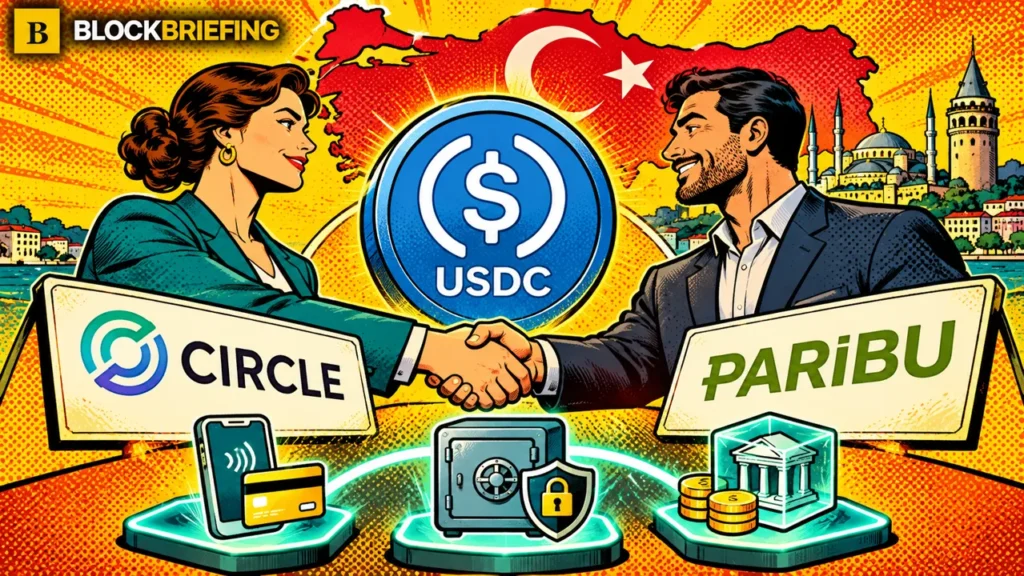
Paribu and Circle International Bermuda Limited have signed a memorandum of understanding to explore new digital finance services in Türkiye, including institutional custody and tokenized real-world assets.
According to the official announcement, the companies disclosed the agreement on November 24. It builds on Paribu’s existing support for USDC transfers through Circle’s Arc blockchain.
Circle and Paribu build on Arc
Paribu already supports USDC deposits and withdrawals through Arc. Its institutional custody business also supports the network. The new agreement extends the scope of discussions beyond those existing services. The parties intend to examine new products based on Arc, as well as custody and tokenization opportunities.
A memorandum of understanding sets out areas in which organizations intend to cooperate. It does not necessarily commit them to a commercial launch or a specific investment. The announcement contains no rollout date for a new payment product.
What the agreement could mean for institutions
Institutional custody is the safekeeping of digital assets on behalf of businesses and other organizations. A custody service can help a company manage access to private keys, record transactions and establish approval procedures. It is distinct from the blockchain itself.
Tokenization involves representing rights to an asset through digital tokens. For example, a token might represent an interest in a financial instrument. The legal rights attached to it depend on the terms of the instrument and relevant law, not simply on the blockchain used to record it.
USDC access and local payment infrastructure
USDC is designed to maintain a value of one US dollar. A blockchain transfer may allow users to move the token outside traditional banking hours, but converting it into local currency still depends on available services, fees and applicable rules.
The agreement does not establish a new Turkish lira conversion service or promise access to USDC for every resident. Customers should distinguish support for transferring a token from the availability of a regulated local payment product.
What remains to be announced
The companies also intend to examine educational, research and developer projects. These could help organizations understand the infrastructure required to use stablecoins in financial services. No budget or timetable was disclosed.
Further announcements would be needed to identify specific products, participating financial institutions and commercial terms. Regulatory permissions and operational safeguards will also matter. The agreement is evidence of planned cooperation rather than evidence of new transaction volumes.
For related background, see BlockBriefing’s crypto regulation tracker.
For a business receiving USDC, the practical costs extend beyond blockchain transaction fees. Converting the balance into local currency may involve a spread, compliance checks and a separate withdrawal fee. Businesses also need to reconcile incoming transfers with invoices and decide who can authorize outgoing payments. These requirements apply even when the underlying network is available around the clock.
Another question is how the parties would divide responsibility for customer onboarding, asset custody and settlement if they launch a joint service. A service provider’s role matters when a payment fails or a customer disputes a transfer. The existing integration offers a starting point for testing these arrangements, but the announcement does not specify a new commercial service or its terms.