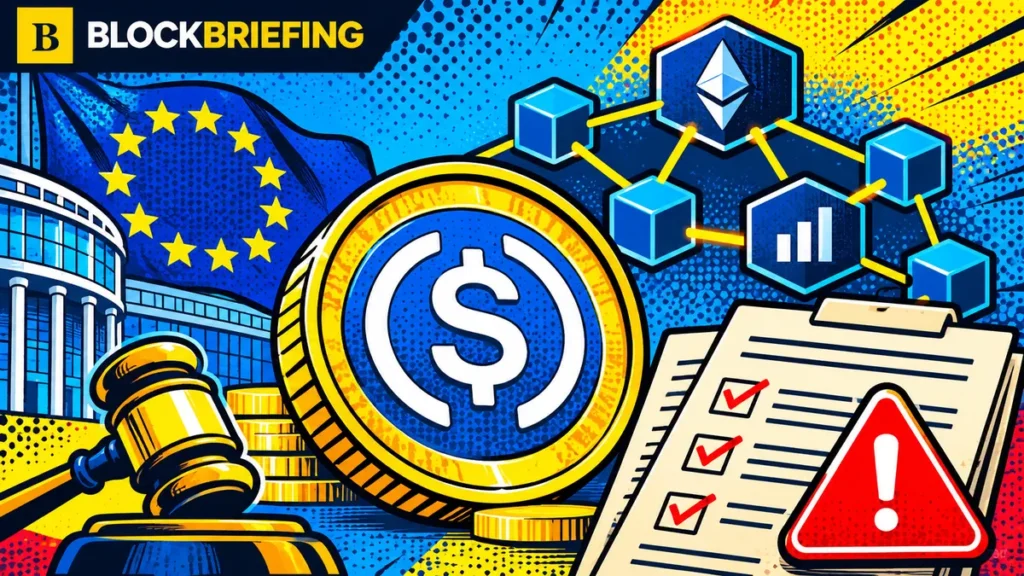
The European Banking Authority has warned that stablecoins are becoming an important bridge between regulated crypto services and decentralized finance, raising questions about consumer protection and regulatory gaps under the European Union’s Markets in Crypto-Assets framework.
In a report published on November 25, the EBA said electronic money tokens and other selected stablecoins play a central role in DeFi borrowing, lending, trading and collateral. The authority recommended that the European Commission assess whether additional requirements should apply to crypto-asset service providers that help customers access DeFi, particularly lending protocols.
Why stablecoins matter to DeFi
Stablecoins are digital tokens designed to track the value of a reference asset, commonly a currency such as the euro or US dollar. In DeFi markets, they can provide trading liquidity, serve as collateral for loans and act as a settlement asset between protocols.
The EBA said some euro-denominated electronic money tokens issued under MiCA are already used in DeFi. This creates links between token issuers, decentralized protocols and regulated firms that provide gateways or interfaces for customers. A service provider may be regulated even when the underlying protocol operates in a decentralized manner.
Consumer protection and regulatory arbitrage
The authority identified several risks for consumers. These include inadequate disclosures, highly leveraged positions, borrowers failing to repay stablecoin loans and operational vulnerabilities in protocols or connected services. Users may lose all of the assets they commit to a DeFi activity, particularly when they do not understand how collateral, liquidation or smart-contract risks work.
The EBA also raised concerns that DeFi structures could be used to avoid parts of MiCA. Its report points to potential attempts to circumvent requirements governing the public offer or admission to trading of electronic money tokens, as well as the prohibition on paying interest on those tokens. The report does not mean every DeFi protocol is deliberately avoiding regulation; it identifies areas where supervisors may need clearer rules and evidence.
MiCA covers the issuance and public offering of certain crypto-assets and the provision of crypto-asset services in the EU. Fully decentralized services provided without an intermediary are generally outside the regulation’s scope. The EBA’s concern is that the practical boundary can become less clear when regulated companies facilitate access to decentralized products.
What the EBA wants policymakers to examine
The EBA noted that DeFi adoption among EU consumers remains limited. Its recommendation asks the European Commission to assess whether additional requirements are necessary for crypto-asset service providers facilitating access, particularly lending, as part of MiCA’s review. It does not itself impose those requirements. The authority said it will continue monitoring stablecoin use and provide further technical input during the MiCA review.
The report also noted that consumer access is becoming easier through crypto service providers and AI-enabled applications. It cited a survey finding that 42% of European-based investors expect to engage with DeFi by 2028. That figure reflects expectations among the surveyed investors, not a forecast that 42% of all European consumers will use DeFi.
Implications for stablecoin issuers and platforms
For issuers, exchanges and wallet providers, the report signals continued scrutiny of how stablecoins move between regulated and decentralized environments. Firms may need to explain more clearly when a customer is leaving a regulated service and interacting with a protocol that carries different protections.
For users, the practical lesson is to assess collateral rules, liquidation thresholds, smart-contract audits and withdrawal conditions before depositing stablecoins into a lending pool. A token designed to maintain a stable price does not make every product built around it safe.
Further regulatory developments will be important for the European crypto regulation landscape and the future of DeFi.