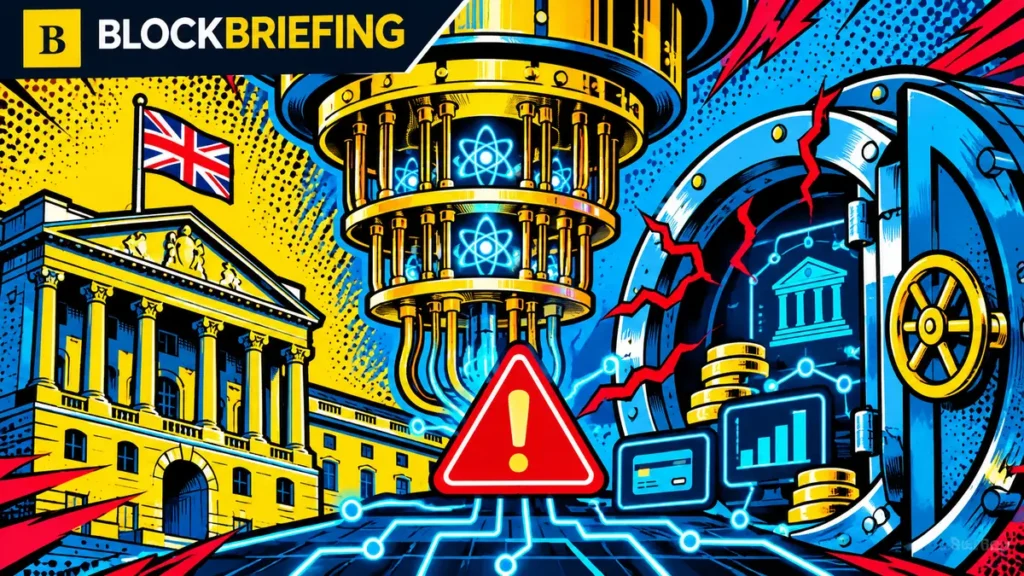
The Bank of England has warned that advances in quantum computing could create operational risks for financial systems by weakening the cryptographic tools used to authenticate users, protect information and verify transactions. The concern is not that a powerful quantum computer has already broken financial networks, but that institutions need to prepare before such a capability emerges.
The warning appears in the Bank’s November 2026 Financial Stability Report, which examines operational risks from quantum computing. The central bank says quantum technology could bring benefits to trading, portfolio management, fraud detection and payment processing, while also challenging widely used public-key cryptography.
Why public-key cryptography matters
Public-key cryptography uses linked public and private keys to secure communications and prove control over digital identities. Financial institutions rely on it for authentication, digital signatures, certificates and the protection of long-lived records. If an attacker could break the relevant cryptographic methods, they might be able to forge signatures or impersonate trusted systems.
The same broad cryptographic principles are important across the digital asset sector. Cryptocurrency wallets use private keys to authorize transactions, while exchanges and custodians rely on cryptographic controls to protect accounts and infrastructure. A future weakness in widely used algorithms could therefore require coordinated upgrades across networks, wallet software and institutional custody systems.
The threat is not immediate, but preparation takes time
The Bank says a cryptographically relevant quantum computer does not currently exist. However, uncertainty about when one might emerge makes preparation important. Financial systems contain long-lived data and infrastructure that cannot always be replaced quickly.
One concern is often described as “harvest now, decrypt later.” An attacker could collect encrypted information today and retain it in the hope that future technology will make it readable. This risk is most relevant to data that remains sensitive for many years. Digital signatures and identity systems raise a separate concern because a sufficiently capable machine could potentially undermine trust in credentials or transaction authorization.
What financial firms and crypto platforms may need to do
Preparation can include identifying where vulnerable algorithms are used, mapping dependencies across suppliers, and planning migration to post-quantum cryptographic standards. Firms also need to test how software updates, hardware security modules, custody systems and customer devices will handle new algorithms.
For blockchain networks, migration is especially complex because users control assets through keys and signatures. A network may need new transaction formats or signature schemes, while wallet providers must help users move to updated security methods. Such changes require careful coordination to avoid excluding users or creating new attack surfaces.
Quantum computing is also a potential opportunity
The Bank’s report does not treat quantum computing only as a threat. It notes potential applications in financial services, including optimization and fraud detection. The challenge is to capture possible benefits while maintaining the confidentiality, integrity and authenticity of financial data.
Institutions should avoid both complacency and exaggerated claims. There is no evidence in the report that current Bitcoin or other major blockchain signatures have been broken by a quantum computer. The issue is long-term resilience and the need to plan before migration becomes urgent.
BlockBriefing will continue following developments in blockchain technology, cryptography and financial regulation.