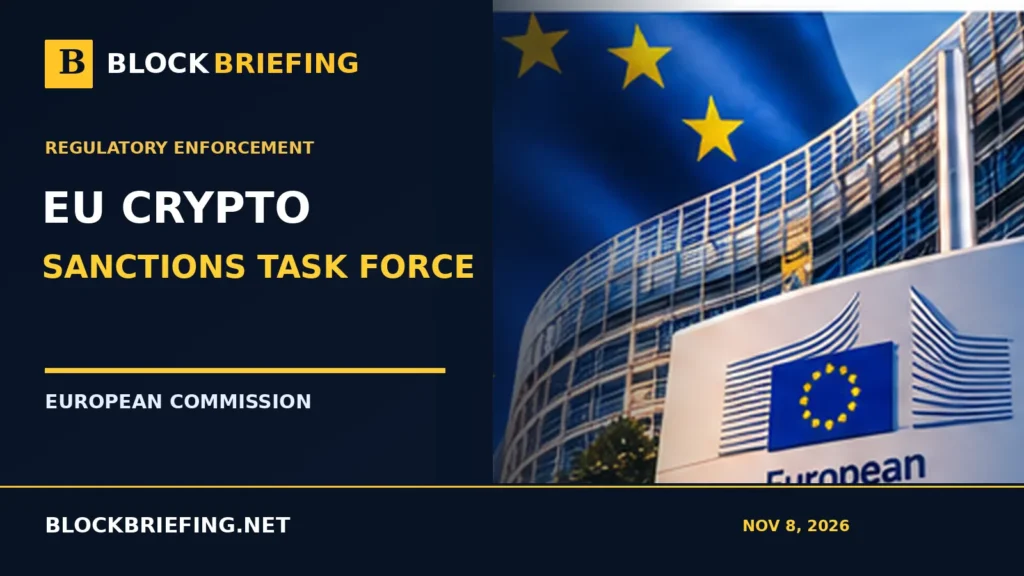
The European Commission has announced a Crypto Sanctions Task Force aimed at detecting the use of digital assets to evade EU financial restrictions, adding an enforcement coordination mechanism without announcing a new blanket ban on cryptocurrency. The move comes as EU authorities examine how payment networks and cross-border transactions can undermine restrictions linked to Russia.
Commissioner Maria Luís Albuquerque announced the task force in an official November 6 statement following a meeting of EU sanctions officials. A Commission press briefing on November 6 subsequently characterized it as an informal group bringing together expertise from the Commission and member states.
New Task Force Focuses On Existing Sanctions Enforcement
Albuquerque said the task force would strengthen the ability to detect and address attempts to circumvent EU financial sanctions through crypto-assets. Officials discussed cooperation between national authorities, EU institutions and the European Anti-Fraud Office, or OLAF, including the exchange of experience from enforcement cases.
The announcement addresses the application of existing restrictive measures. It did not itself specify a new licensing process for wallets, a ban on self-custody or a list of newly prohibited tokens. Treating the statement as a fresh crypto prohibition would misrepresent what the Commission has actually announced.
Commission Briefing Clarifies Informal Structure And Shared Expertise
At the November 6 briefing, a Commission spokesperson explained that the purpose was to bring together specialist knowledge from across the EU institutions and member states to identify methods of circumvention and inform possible responses. The briefing described crypto as a fast-moving area in which enforcement authorities need both financial and technical expertise.
This distinction matters for exchanges, payment providers and blockchain investigators. A task force may change how authorities coordinate investigations and identify risks even before a new legislative proposal appears. But the creation of an informal group should not be confused with a directly applicable legal obligation absent further published measures.
| Source | Confirmed development | Not established by announcement |
|---|---|---|
| Commissioner, November 6 | Launch of EU Crypto Sanctions Task Force | New universal cryptocurrency ban |
| Commission briefing, November 6 | Informal coordination of Commission and member-state expertise | New statutory enforcement powers |
| Sanctions Envoy, November 6 | Partners discussed payment-network and crypto circumvention | Named investigations or prosecutions arising from this group |
Payment Networks And Third Countries Draw EU Attention
In a separate official statement, EU Sanctions Envoy David O’Sullivan described discussions with member states and international partners on emerging circumvention patterns, safeguarding the banking sector and responses to crypto-led evasion schemes. The forum included representatives from countries outside the EU as well as EU members.
The Commission’s November 5 meeting agenda also identified payment networks in third countries and financial channels supporting Russia’s war effort as topics. These documents show that authorities are looking beyond transactions directly touching a single EU-regulated trading platform.
Crypto Businesses Should Distinguish Coordination From New Rules
The immediate development is institutional: stronger information sharing, coordinated analysis and an announced forum for crypto-sanctions expertise. The Commission has not published a dedicated technical protocol explaining wallet-screening thresholds, mandatory chain-analysis methods or how the task force will publish case outcomes.
Firms already subject to EU sanctions obligations should continue relying on binding EU regulations, official designation lists and national regulatory instructions. The new group does not replace those legal sources. It also does not establish that any specific blockchain, token or privacy tool is unlawful merely because it is used in transactions potentially relevant to investigators.
The next test will be whether the task force produces official guidance, coordinated investigations or proposals with concrete obligations. Until then, the verified November 6 announcement is best described as an enforcement initiative, not new crypto legislation.
Reporting note: This analysis is based on primary European Commission statements and the Commission’s own briefing record. No draft regulation or enforcement order specific to this task force was identified in those materials.