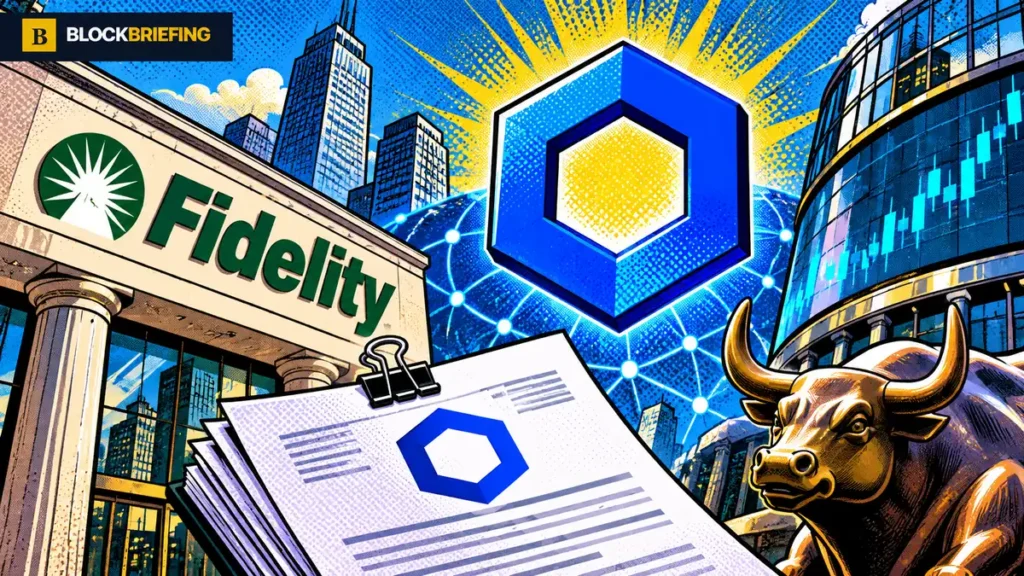
Fidelity has filed to launch an exchange-traded product that would give investors exposure to Chainlink’s LINK token through a traditional brokerage account. The proposed fund would hold LINK directly, rather than rely solely on derivatives. Its filing marks a new step in the expansion of regulated crypto investment products.
On November 25, the firm submitted a preliminary Form S-1 registration statement to the U.S. Securities and Exchange Commission. The document identifies the Fidelity Chainlink Fund and sets out plans for its shares to trade on Nasdaq. The proposal is not a confirmation that trading has begun.
How the Fidelity Chainlink ETF would work
The fund aims to follow the dollar price of LINK after accounting for expenses and liabilities. It would use a reference rate based on spot market prices, combining trading information from eligible venues through a volume-weighted median calculation. The proposed methodology updates the rate every 15 seconds using rolling market data.
This approach matters because crypto assets can trade at different prices on separate exchanges. An index that combines multiple venues can help reduce the influence of an unusual price on a single platform. It does not, however, eliminate the risk of sharp moves across the broader market.
Investors would own shares in the product rather than LINK tokens in a personal wallet. They would therefore gain financial exposure without directly managing blockchain transactions or private keys. In return, they would face the costs and restrictions associated with an exchange-traded investment.
Why the filing matters for Chainlink
Chainlink provides infrastructure that connects blockchain applications with external information. Its network can support services such as price feeds used by decentralized finance applications. LINK is the network’s native asset.
A spot product could offer another route for investors who prefer to use conventional securities accounts. That potential expansion in access is distinct from adoption of the underlying network. Buying a fund share is not the same as using Chainlink’s services, and the existence of a fund does not guarantee sustained demand for LINK.
For readers following the wider market, our ETF and institutional coverage tracks developments across digital asset investment products.
What investors should watch next
The registration statement is preliminary. Investors should look for amendments, final offering terms, the fund’s expense structure and confirmation of when shares can begin trading. Details in an initial registration document may change before a product launches.
Even if the fund becomes available, its performance would remain tied to a volatile digital asset. Market liquidity, custody arrangements and fund expenses are relevant risks. Share prices may also differ from the value of the underlying assets during trading.
The filing is a concrete milestone in Fidelity’s proposed product development, but it should not be interpreted as an SEC endorsement of Chainlink or a forecast of LINK prices. The next meaningful milestone will be confirmation of the final terms and effective registration.