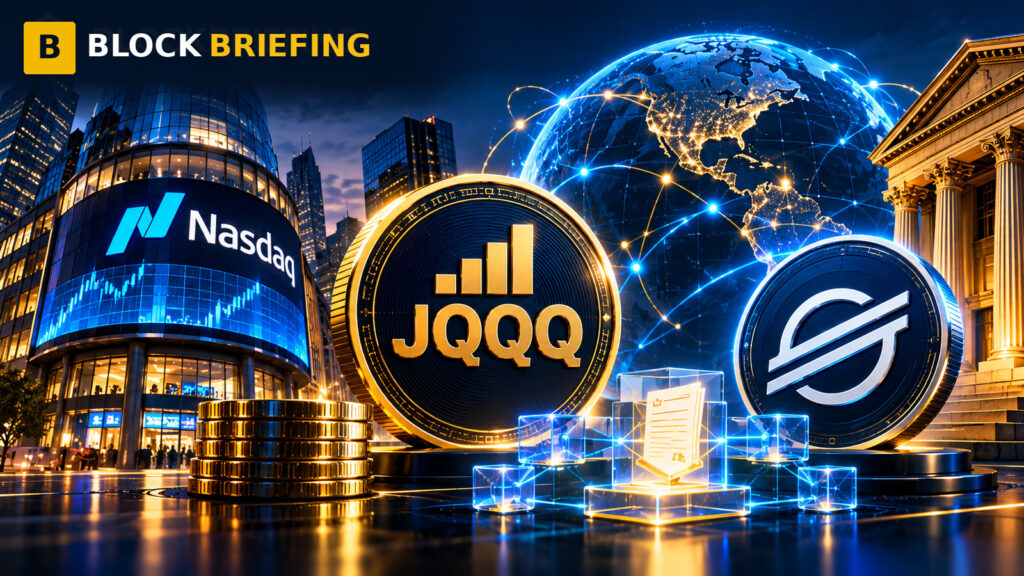
Janus Henderson and tokenization specialist Centrifuge unveiled JQQQ on October 27, a blockchain-native fund designed to provide eligible investors with exposure to the Nasdaq-100 Index through a licensed, issuer-sponsored strategy. The fund will be issued on the Stellar network, bringing a widely followed US equity benchmark into an onchain fund structure.
The official Janus Henderson announcement says the fund seeks to track the Nasdaq-100 under license from Nasdaq. Centrifuge provides the underlying tokenization infrastructure. The arrangement differs from an unlicensed token that merely mirrors the price of a stock or index.
How the JQQQ fund is structured
JQQQ is a segregated portfolio within Anemoy Capital SPC Limited, a British Virgin Islands company. Anemoy Asset Management Limited serves as investment manager, with Janus Henderson Investors US LLC as sub-investment manager. The fund offers indirect economic exposure to an index-tracking investment product rather than direct ownership of the Nasdaq-100 constituents.
The companies describe this as an issuer-sponsored fund designed to operate on public blockchain infrastructure. Stellar is the initial and exclusive blockchain network for issuance. Centrifuge’s separate launch explanation highlights programmable fund operations and potential links to onchain financial applications.
Such applications could eventually include portfolio vaults, lending or collateral arrangements, but those features are possibilities rather than guaranteed services available to every holder. Independent third parties may provide them, subject to applicable requirements.
Who can invest, and what are the risks?
An important limitation is that JQQQ is not available to US persons. It is offered only to eligible investors in jurisdictions where distribution is lawful. That makes the fund very different from a publicly accessible US exchange-traded fund, even though its strategy references the same equity benchmark.
Janus Henderson also warns that a tokenized fund involves conventional investment risks plus the possibility of wallet, smart-contract, network or platform problems. A fund’s value may diverge from the performance of the index, and investors have no direct shareholder rights in the index constituents by virtue of holding the fund.
Why institutional tokenization matters
Janus Henderson says its onchain investment platform now includes more than $1 billion in institutional strategies spanning Treasuries, structured credit and equities. That company-reported figure refers to its broader tokenized platform, not to assets raised by JQQQ at launch. The companies did not disclose initial JQQQ subscriptions in the announcement.
The new product sits within a broader effort to connect established capital-market products to digital asset infrastructure. BlockBriefing recently covered BlackRock, SBI and Startale’s exploration of tokenized funds and yen stablecoins, another project at the intersection of institutional investing and blockchain settlement.
JQQQ’s commercial significance will depend on actual investor participation, disclosure quality, liquidity and the availability of compliant distribution channels. The license and launch are confirmed; broad adoption remains to be demonstrated.
Source review: Janus Henderson’s October 27, 2026 press release and Centrifuge’s issuer-side launch article. This report distinguishes current fund issuance from prospective third-party uses.