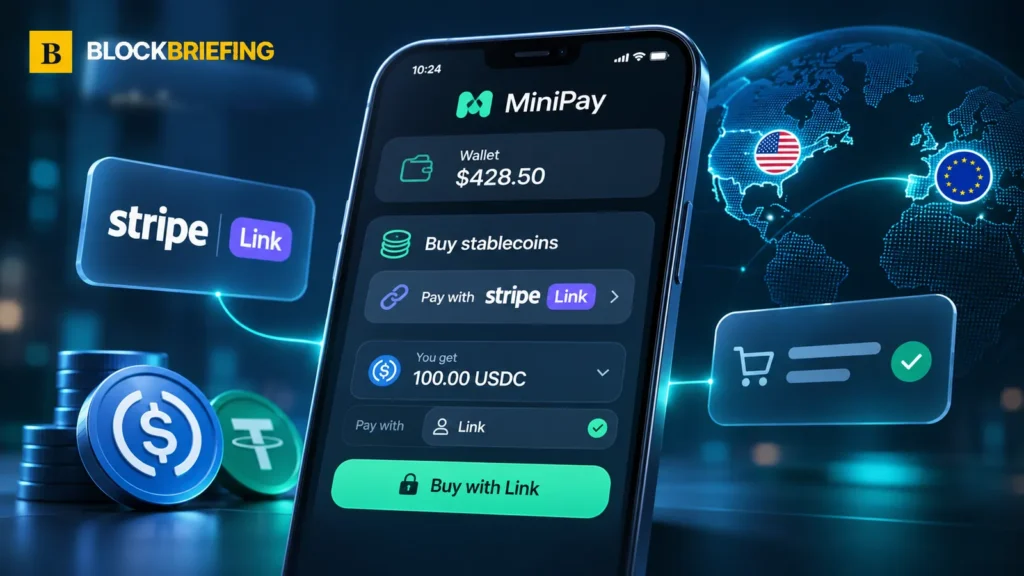
Celo says MiniPay users in the United States and European Union can now purchase dollar-linked stablecoins through Stripe’s Link checkout. The integration adds another way to put funds into a crypto wallet, reducing the need for eligible customers to first acquire tokens on a separate exchange.
The November 12 announcement reported by CoinNess describes a payment flow connecting Link with the MiniPay wallet. The feature’s availability is subject to eligibility, payment methods and local restrictions. A familiar checkout process does not itself guarantee the value of the stablecoin received.
Link checkout adds a funding route for MiniPay wallets
Celo’s announcement says users may use supported dollar tokens to pay transaction fees, reducing the need to maintain a separate native token balance solely for routine network operations. Actual wallet behavior still depends on supported assets, current fees and successful processing of each transfer.
For a new user, the most important distinction is between making a purchase through a recognizable payment interface and taking custody of a blockchain asset afterward. A transaction can begin with standard checkout controls yet end with funds in a wallet that requires the user to preserve recovery credentials. Conventional payment authentication does not remove that responsibility.
Stablecoin transfers still depend on custody and fees
Public coverage of the announcement refers to Link’s large existing consumer footprint. That figure reflects familiarity with the wider checkout service and should not be presented as the number of MiniPay users purchasing stablecoins through the new integration. The launch has not yet been accompanied by independently verified transaction volumes or conversion figures.
MiniPay and Celo supporters have reported significant wallet activation and transaction milestones. Such cumulative figures may include activity predating this feature, as well as repeat transactions by the same user. They offer context for the network’s scale but cannot establish how many people will choose a particular on-ramp in Europe or the United States.
Link’s existing user base is not MiniPay adoption
Cost is another unresolved consideration. Consumers may encounter a purchase spread, card or banking charges, currency conversion, or network transaction fees, depending on the provider and route. The announcement does not demonstrate that every purchase costs less than transferring stablecoins from an existing exchange account.
The ability to obtain stablecoins inside a familiar wallet could make a previously complicated process more accessible. But customers still face issuer risk, price deviations, wallet compromise and regional restrictions. The results worth tracking are successful purchases, transparent total costs, reliable redemptions and support when transactions do not complete as expected.
The announcement did not provide an audited count of purchases completed through the new integration or a comparable cost analysis against competing funding services. Users may still face spreads, processing charges and blockchain transaction fees. Those costs must be assessed for the actual amount and payment route used.
Once stablecoins reach MiniPay, key management and transaction finality become relevant even though the purchase began through a conventional payment screen. BlockBriefing’s crypto custody guide explains why that distinction matters. Its report on EU stablecoin supervision gives related regulatory context without implying that every stablecoin or wallet in this launch has the same legal status.