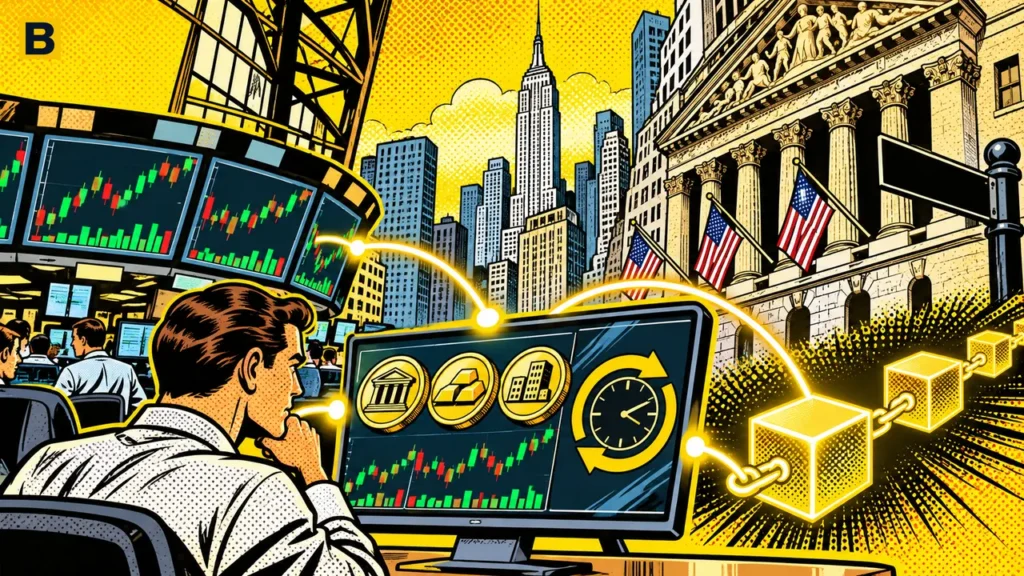
OKXICE set November 23 as the planned opening date for round-the-clock trading in tokenized US securities. The joint venture between OKX and Intercontinental Exchange expects to list more than 70 assets for eligible US users. BlockBriefing could verify the planned date through OKX’s announcement. Live trading has yet to be independently confirmed.
In its launch announcement, OKX said the list is expected to include securities from Coinbase, Circle, BitGo, Better.com, Robinhood, Securitize and Strategy. The company also named 59 Direxion ETFs and said Strategy plans to list preferred shares. The announcement describes the lineup it expects to offer, so the exact instruments available at opening can be checked once the venue is live.
How OKXICE plans to run trading
Eligible customers would access the Tokenized Securities Venue through the OKX app. OKX says customers must activate a CeDeFi Wallet and complete OKXICE onboarding, including identity verification. Geographic and other eligibility conditions apply. The November 23 start therefore applies to qualifying US customers who have completed those steps.
OKX says trading would run through Uniswap v4 liquidity pools on X Layer, its Ethereum layer 2 network. A liquidity pool holds assets that users trade against. In this setup, the venue says its smart contracts limit trading and contributions to the pools to eligible wallets.
Securitize is providing the tokenization infrastructure, according to OKX. Each token is meant to represent a security entitlement backed one to one by an underlying US share. OKX says the structure is intended to carry applicable shareholder rights and economic benefits, including dividends and voting rights. Customers would hold the tokens in their own wallets, with responsibility for their wallet keys.
What the OKXICE launch date establishes
OKX says the venue is offered under a temporary Securities and Exchange Commission exemption. The company describes OKXICE as a venue operating under that exemption. Its announcement also says the venue is neither a registered exchange nor a registered broker-dealer and has no SEC approval. Those details matter when comparing this service with a conventional US stock exchange.
The venture’s plan would allow eligible customers to use the venue beyond the regular hours of US stock markets. The published announcement describes the venue’s own trading rules and access conditions. It does not establish that every named instrument will be available at the same time or that the underlying shares change their trading hours.
Other institutions have taken a different approach to tokenization. HSBC’s tokenized money market fund puts a share class of a Hong Kong dollar fund on Ethereum. OKXICE plans to bring several issuers’ securities and ETFs into one venue. Its launch announcement describes how those instruments would be held and traded by eligible customers.
The first operational milestones are confirmation that eligible users can access the venue and a list of the assets actually available for trading. Until that confirmation is public, the verified news is the November 23 start date set by the operator and the structure it disclosed for the venue.
ICE is the parent of the New York Stock Exchange. Its role here is as a joint-venture partner with OKX. The company announcement describes a separate venue with its own onboarding, wallet and liquidity systems. The proposed holdings and trading setup therefore differ operationally from buying shares directly on a traditional exchange.