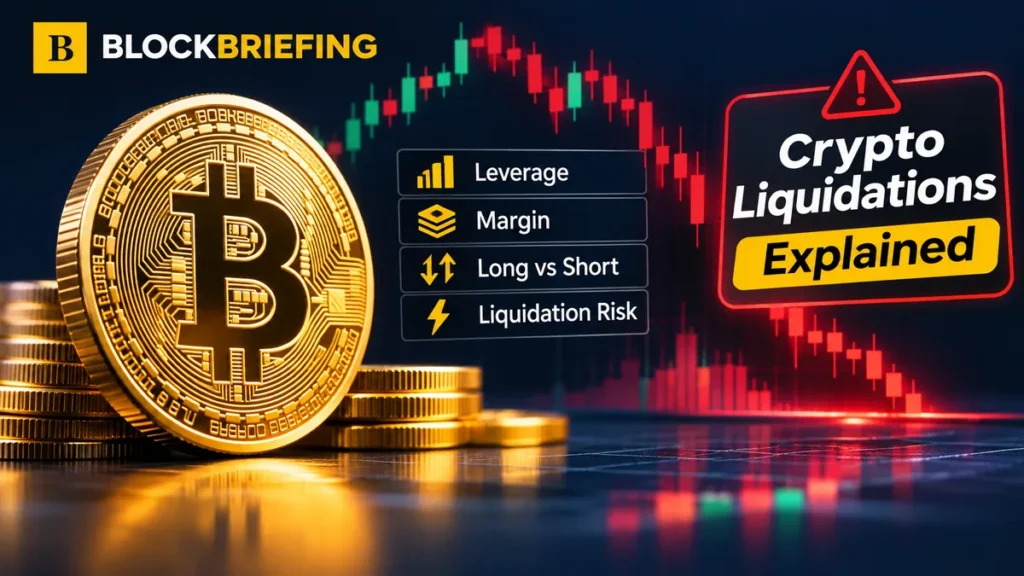
Crypto liquidations occur when a trading platform forcibly reduces or closes a leveraged position because the trader’s available margin no longer meets its requirements. The term frequently appears in  Bitcoin market price and chart market reports, but liquidation totals need context: they describe derivatives positions closed under a venue’s risk rules, not the total value of cryptocurrency sold across every market. Bybit’s official liquidation procedure explains how mark price and maintenance margin affect forced closures.
What triggers a crypto liquidation?
A trader using leverage controls a position larger than the collateral initially committed. If the market moves against that position, unrealized losses erode the margin cushion. An exchange can intervene when equity or position margin falls below its maintenance requirement. The trigger varies by venue, contract, margin mode, risk tier, funding and fees; a simple percentage price move is not a universal liquidation rule.
A simplified Bitcoin leverage example
Suppose a trader posts $1,000 in collateral to open a $10,000 Bitcoin long using 10x leverage. Ignoring trading costs, a 5% decline in the position’s value represents a $500 unrealized loss, or half the posted collateral. A further decline reduces the cushion. The precise liquidation threshold cannot be calculated from leverage alone because maintenance margin, fees and exchange rules also matter. This example describes mechanics, not a suggested trade.
Why mark price differs from the last trade
An exchange may trigger liquidation using a mark price designed to reflect broader market value rather than a single last-traded print. Consequently, a default candlestick chart might not show the exact price that activated liquidation. Bybit explicitly states that mark price, not last traded price, determines its isolated-margin trigger. Check the specific contract documentation before interpreting a published liquidation level.
Long liquidations versus short liquidations
Long positions typically come under pressure when prices fall; short positions typically come under pressure when prices rise. News reports may aggregate estimated long and short forced closures across exchanges. These figures are not necessarily comparable across data vendors because exchange participation, reporting delays and contract valuation methods differ. Liquidations can intensify price moves, but a large total does not by itself establish the direction of the next move.
Isolated margin and cross margin risks
With isolated margin, collateral is assigned to a position, although exchange-specific rules still apply. Cross margin draws on a shared account margin pool and can expose other available account collateral to the same position’s losses. Some platforms also employ partial liquidation, automatic order cancellation or risk-tier adjustments before a full close. Review Bybit’s maintenance-margin explanation for an example of how those tiers are calculated.
How to interpret liquidation charts responsibly
To distinguish different derivatives metrics, read BlockBriefing’s explainers on Bitcoin funding rates and crypto open interest. Funding reflects periodic transfers, open interest tracks outstanding contracts, and neither is a liquidation count.
First identify the source, instruments and reporting window: BTC perpetual swaps are not equivalent to every Bitcoin trading venue. Next separate forced closing activity from spot volume, open interest and net buying or selling. A liquidation cluster can coincide with high volatility without proving causation. For market context, compare the relevant exchange’s OHLCV observations with independently timestamped derivatives data and identify any missing venues.
Frequently asked questions
Does a stop-loss always prevent liquidation?
No. Gaps, thin liquidity, execution slippage, mark-price triggers and exchange-specific order rules can prevent an order from filling before a liquidation event.
Can a trader lose more than initial margin?
The outcome depends on the venue, product, negative-balance protections and margin mode. Do not assume that collateral is the maximum possible loss without reading the contract terms.
Compare market sentiment cautiously with the Crypto Fear and Greed Index explainer. Read BlockBriefing’s chart-reading guide, risk-to-reward explainer and trading calculators for related concepts. This article is educational, not personalized investment advice.