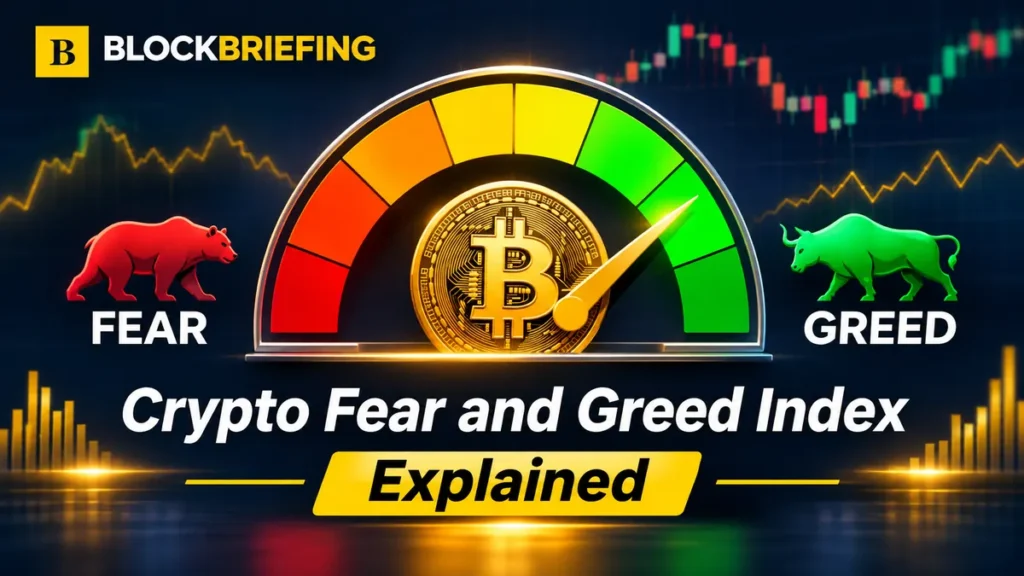
The Crypto Fear and Greed Index condenses selected market and attention signals into a sentiment score, typically shown on a scale from zero to 100. Lower readings indicate greater fear according to the provider’s model, while higher readings indicate greed. The frequently cited index is published by Alternative.me, which provides its methodology, historical values and API. Its score is a proprietary interpretation, not a measurement of what every investor actually feels.
What does a Fear and Greed score measure?
Alternative.me labels the low end of its scale extreme fear and the high end extreme greed. It combines indicators related to  Bitcoin market price and chart volatility, trading momentum and volume, social interest, market dominance and search trends. The provider says its currently described index is focused on Bitcoin; a website displaying that reading should not imply it independently measures every altcoin. Scores can change as input data and market conditions evolve.
How the index methodology works
Alternative.me’s published methodology assigns 25% each to volatility and market momentum or volume, 15% to social media, 10% to Bitcoin dominance, and 10% to Google Trends. It also lists a 15% survey component as paused. Because that component is inactive, readers should not assume the historic percentage labels represent an unchanged live weighting scheme. The provider, rather than third-party commentators, remains the authoritative source for updates to its model.
What extreme fear does not prove
A low score can coincide with sharp price declines or defensive market behavior, but it is not proof that Bitcoin has reached a bottom. Fear can persist through a prolonged downtrend, and volatile conditions may continue after a reversal. A score alone also cannot distinguish macroeconomic pressure from exchange-specific problems or protocol news. It is best treated as context rather than an entry instruction.
What extreme greed does not prove
A high score does not guarantee an imminent crash. Momentum can remain strong while a sentiment measure stays elevated, and the timing of a reversal is uncertain. Nor can the index establish whether a price increase is supported by exchange volume, ETF flows, liquidity depth or spot buying. Analysts should examine those observations separately rather than equating a survey-like label with executable market evidence.
Compare sentiment with observed market data
A reproducible market assessment begins by recording the index value, classification, provider and observation time. Then compare the reading with completed price candles, turnover, volatility, funding or open interest where relevant. BlockBriefing’s cryptocurrency market-data hub provides indicative provider-sourced snapshots; its historical samples are not exchange-native OHLCV candles. For research-grade comparisons, keep instruments and timestamps consistent.
Why different sentiment indexes disagree
Other firms may publish a Fear and Greed label while using different inputs, assets, lookback windows, data vendors and normalizations. Two numerical scores are not interchangeable merely because they share the same name. Check which asset universe each score covers, how often it updates and whether historical observations have been revised. When citing numbers, link to the specific provider rather than an unattributed screenshot.
Can websites embed the index?
Alternative.me documents a public endpoint at api.alternative.me/fng/ and provides an embeddable graphic. Its published reuse terms require prominent source attribution next to the displayed values and prohibit presenting the data as another provider’s service. Any on-site implementation should also disclose caching and refresh timing, and gracefully handle unavailable data instead of showing a stale score as current.
Frequently asked questions
Is the index a reliable trading signal?
It can be useful context for market sentiment, but it is not a stand-alone forecasting system and should not be presented as proof of future returns.
Does the Bitcoin index cover every cryptocurrency?
No. Verify each provider’s stated scope before drawing conclusions about individual altcoins from a Bitcoin-focused measure.
Market sentiment alone does not establish a derivatives squeeze: see crypto liquidations explained. For further context, read how to read crypto charts and how to assess crypto news impact. This educational explanation does not recommend buying or selling any asset.