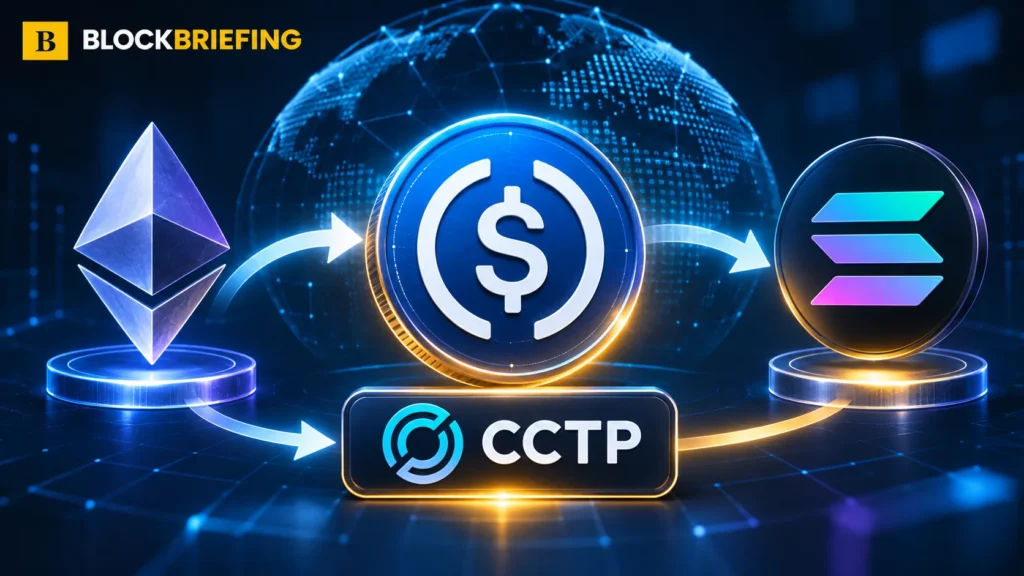
Circle’s Cross-Chain Transfer Protocol (CCTP) lets supported digital assets move between blockchains through a process coordinated by smart contracts and signed attestations. For native USDC, the familiar process burns tokens on the source network and mints an equivalent amount on the destination. It differs from a liquidity-pool bridge that uses existing token reserves on both networks.
Circle’s official CCTP documentation describes the sequence of source-chain action, off-chain attestation and destination-chain completion. Support now covers other assets and interoperability models as well, so users should confirm which method applies to their particular token rather than assume every CCTP transfer is a USDC burn-and-mint.
How does a CCTP transfer work?
A native USDC transfer begins when an application initiates an authorized burn of USDC on the supported source chain. The protocol records a cross-chain message containing information required to complete the movement. Circle’s attestation service observes the event and, subject to the applicable finality conditions, produces a signed attestation.
That message and attestation are then supplied to the destination network, where the corresponding native USDC can be minted for the designated recipient. Some integrations automate the relay or forwarding step. Users should not interpret an initial source-chain confirmation as proof that the destination mint is complete.
How is CCTP different from a normal bridge?
Liquidity-based bridges often keep token balances on both networks and release assets from the destination pool when a source-side transfer is observed. A lock-and-mint bridge may hold collateral and issue a wrapped representation. Native USDC movement through CCTP instead uses a burn-and-mint process, which avoids relying on a destination liquidity pool for the token being issued.
This distinction matters because a wrapped token may depend on a separate bridge operator, custodial arrangement or redemption path. With native USDC, issuer and protocol risks still exist. For a broader comparison of models, read BlockBriefing’s crypto bridges explainer.
What are attestations and finality?
An attestation is a signed message used to confirm that a qualifying source-chain action occurred. Its validity depends on the protocol’s attestation infrastructure and verification rules. Finality describes how confident the system must be that the source event will remain part of the accepted blockchain history before proceeding.
Circle distinguishes different transfer modes and finality assumptions. A faster supported route may make an attestation available earlier, but the applicable fees and risks differ from standard settlement. Review the current protocol documentation for the exact asset and networks, especially when a chain could reorganize or experience an outage.
Does CCTP charge fees?
A CCTP-based transfer can involve source-chain gas, destination execution costs and protocol or application-level charges. Circle’s published schedule distinguishes transfer types and optional forwarding services. A network may also change its own gas price as demand increases. The final payable amount depends on the current route and integration.
Do not assume that burning 100 USDC guarantees exactly 100 USDC of spendable balance at the destination after every service charge. Review the application quote, permitted transfer amount and fee breakdown before confirming. BlockBriefing’s Ethereum gas-fee guide explains one component of transaction costs.
What can go wrong during a transfer?
Wrong destination: an incorrect network, token version or recipient address can make funds inaccessible. Delayed attestation: finality or infrastructure delays can prevent immediate completion. Execution failure: a destination transaction may need retrying or additional gas. Application risk: third-party interfaces, relayers and smart contracts can introduce separate vulnerabilities.
A user may also confuse native USDC with a bridged token that uses a similar ticker. Verify the network and contract using Circle’s current official information. If a transfer fails, keep the transaction hash, source chain and any destination status; use official support and never disclose wallet recovery phrases. See what to check after a wrong-network transfer.
How can you verify a CCTP transfer?
- Check that the application supports the exact asset and source and destination networks.
- Record the source transaction hash from the wallet or application.
- Inspect the source-chain event on an explorer for the actual source network.
- Check whether an attestation is available through the application’s documented status process.
- Confirm the destination mint or receipt using the destination-chain explorer.
- Check the received token contract, amount and any separate fees before treating the transfer as complete.
Frequently asked questions
Is CCTP the same as USDC.e?
No. Native USDC moved via CCTP is distinct from bridge-issued representations such as assets labeled USDC.e. Token contract and issuer details must be verified.
Does CCTP guarantee an instant transfer?
No. Attestation, finality and destination-chain conditions can create delays, even where faster transfer options are available.
Can a completed transfer be reversed?
Confirmed blockchain transfers are generally irreversible through ordinary customer support. Recovery depends on the specific event, protocol rules and control of the receiving address.
Primary sources and related reading
Primary technical source: Circle CCTP overview and documentation. For BlockBriefing’s reporting on newer CCTP functions, see Circle’s multi-asset cross-chain expansion. Features, supported chains and fees change; confirm them with the provider before acting. This guide is educational and is not a transfer recommendation.