
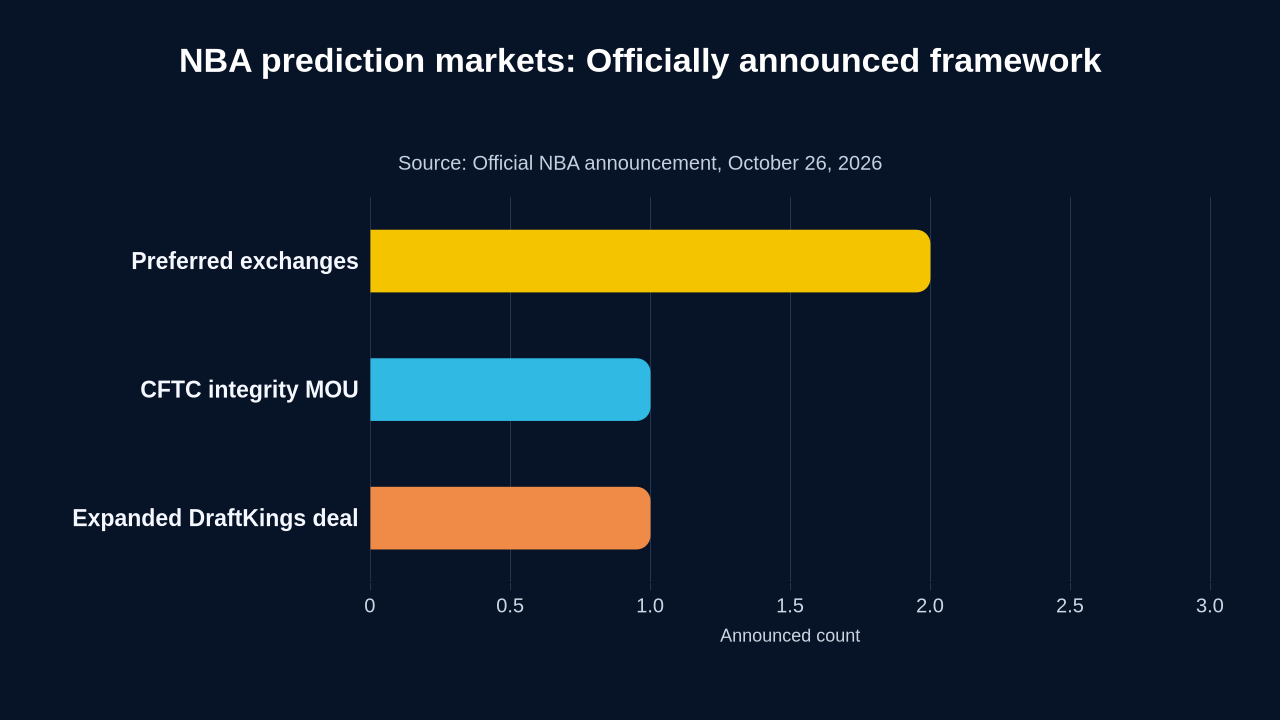
The NBA has named Kalshi and Polymarket its preferred prediction market exchanges and signed an information-sharing agreement with the US Commodity Futures Trading Commission. The league announced the framework on October 26, bringing two major event-contract platforms into an official partnership with professional basketball.
The deals give the two exchanges access to official league data and marketing rights, but they also add rules intended to protect games from insider trading and manipulated markets. The announcement goes further than a simple sponsorship: it lays out what kinds of NBA contracts the platforms can offer and how suspicious trading should be handled.
What the NBA, Kalshi and Polymarket agreed
Under the arrangement, Kalshi and Polymarket become the NBA’s Preferred Prediction Market Exchanges. The league says each partner may use certain NBA intellectual property in US media promotions and receive official game data through Sportradar, its data distribution partner. That data can support the operation and settlement of authorized NBA-related markets.
The NBA also extended its existing relationship with DraftKings to cover prediction markets and nationwide promotion. DraftKings is part of a broader group of authorized operators, but the NBA did not designate it as one of the two preferred exchanges named in this announcement. The distinction matters when comparing each company’s rights.
New restrictions focus on insiders and suspicious trading
The NBA says the arrangements include restrictions on which contracts may be offered, explicit bans on NBA and team personnel trading in the league’s event contracts, and obligations to share information about investigations and unusual activity. These terms are designed to address risks that become more serious when people with non-public information can trade on game outcomes.
For a sports-linked event contract, access to injury news or internal team decisions can create unfair advantages. Restrictions on covered personnel and the types of permitted markets are intended to reduce that risk. Still, the NBA’s statement does not publish a detailed list of every contract that the exchanges will be allowed to offer.
What the agreement with the CFTC does—and does not do
The league separately signed a memorandum of understanding with the CFTC for cooperation and information-sharing on prediction markets. The NBA presented the move as part of a framework for oversight and market integrity.
The memorandum does not itself mean every prediction contract has received a new regulatory approval. An information-sharing framework is different from a formal rulemaking process or a final court decision about a particular type of contract. Readers should not treat the agreement as a blanket legal clearance for all sports markets.
Why this matters for crypto-linked prediction markets
Prediction platforms have become a major intersection of sports, financial technology and crypto infrastructure. Some platforms use blockchain-based infrastructure or digital assets, while others operate under different trading and settlement models. These businesses should not be described as identical simply because they offer event contracts.
The NBA’s move gives approved operators access to league-controlled commercial rights and official data while setting out integrity obligations. It may also influence the standards other sports leagues ask of prediction-market companies, although no additional partnerships can be assumed from this deal alone.
BlockBriefing previously covered Webull and Kalshi’s separate plan for crypto-linked derivatives and the broader growth of Robinhood’s prediction-market business. These are distinct developments, not parts of the NBA agreement.
What comes next
- Details of the NBA event contracts each exchange is permitted to list.
- How the platforms implement information-sharing, surveillance and restrictions on league personnel.
- Whether the NBA expands similar integrity terms to more authorized operators.
The report is based on the NBA’s official October 26 release. No competitor reporting, unsourced trading volumes or speculative contract listings were used. Event contracts can involve substantial losses, and availability and legal rules vary by jurisdiction.