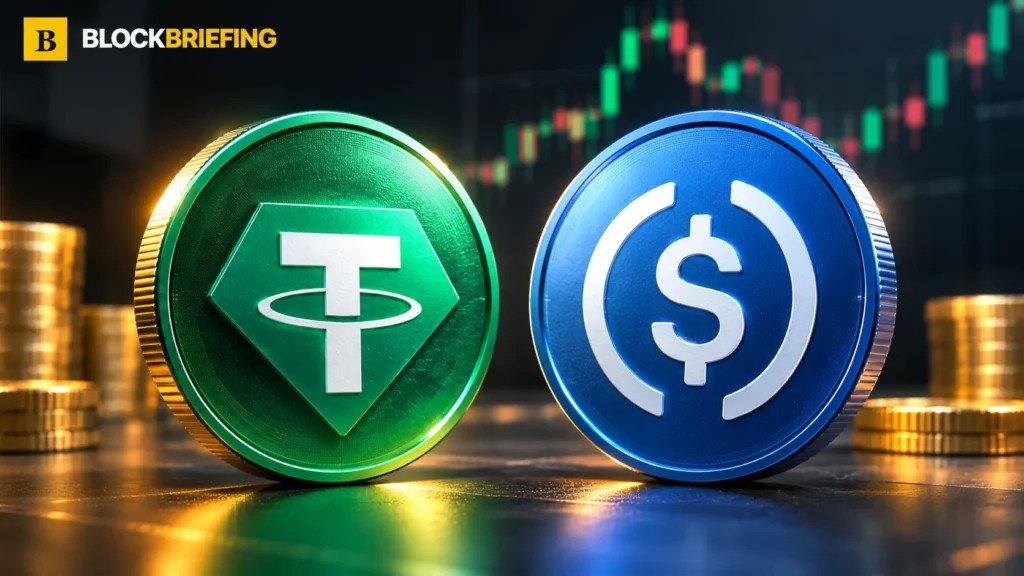
USDT vs USDC: both are dollar-referenced stablecoins designed to track the US dollar, but they are issued by different companies and have different reserves, reporting practices and direct redemption conditions. Neither token is the same as cash in a bank account. Choosing between them requires more than comparing their ticker symbols or price charts.
Circle publishes USDC reserve information with regular reports and monthly third-party assurance, while Tether publishes quarterly reserve reports and circulation information for USDT. Readers should use the latest dated reports, rather than assume a past reserve mix remains unchanged.
Who issues USDT and USDC?
USDT is issued by entities within the Tether group, subject to its relevant terms. USDC is issued by Circle entities, with different legal issuers and terms across certain jurisdictions. Both instruments aim to maintain a dollar reference value, but ownership of a token does not automatically qualify every holder for direct dollar redemption from its issuer.
There is also an important difference between holding an issuer-native token and holding a bridged or wrapped representation. A copied ticker on another network may introduce a separate issuer, bridge or redemption risk. Always identify the exact token contract and network before sending funds.
How are USDT and USDC reserves disclosed?
Circle says USDC reserves consist of highly liquid cash and cash-equivalent assets, including short-term US government obligations, and describes weekly reserve disclosures and monthly independent assurance. Tether publishes reserve reports based on its own accounting and assurance arrangements, with categories that can include Treasury instruments, precious metals, Bitcoin and other assets. The composition can change, so comparing today’s USDC disclosure with an old USDT report would mislead readers.
A reserve attestation is not the same thing as an audit of every activity of an issuing company. Read the assurance report’s subject matter, the as-of date, liabilities covered, valuation assumptions and accountant’s conclusion. For a detailed method, see BlockBriefing’s guide to verifying stablecoin reserves.
Can anyone redeem USDT or USDC for dollars?
No. Direct issuer redemption generally requires eligibility and verification. Circle says Circle Mint is intended for eligible institutions, while retail users commonly trade or convert USDC through wallets, exchanges or other intermediaries. Circle’s legal terms govern direct redemption, including jurisdiction and account restrictions.
Tether’s published fees page specifies a minimum direct acquisition or redemption amount of $100,000 equivalent and charges subject to change; verified account requirements also apply. This is not the minimum amount someone can trade on an exchange. A person exchanging a small balance usually relies on third-party liquidity and whatever price, fee and withdrawal conditions that platform offers.
Are USDT and USDC always worth exactly $1?
Both target a one-dollar value, but the market price on an exchange may deviate above or below it. Liquidity, redemption access, market confidence, chain congestion and operational interruptions can influence secondary-market quotes. The issuer’s stated redemption arrangement does not mean every exchange must offer an exact $1 sale price at all times.
A temporary discount does not by itself prove that reserves are missing. Equally, a published reserve report does not eliminate operational, legal or counterparty risks. If the purpose is a payment, consider whether the receiving party can convert the specific token without delay.
Which blockchain networks support them?
USDT and USDC both exist across multiple blockchain networks, but not every exchange, wallet or payments provider supports every version. Fees and settlement speeds depend on the chain and transaction conditions, not just whether the asset is USDT or USDC. An Ethereum transfer and a transfer over another supported network can carry very different fees and operational requirements.
Before moving funds, confirm the destination’s supported deposit network, token contract, wallet address and any required tag. Read the wrong-network recovery guide if a transfer was made using an unsupported route. Sending a test transaction can reduce some operational mistakes, but it cannot guarantee recovery.
Can USDT or USDC balances be frozen?
Both issuers have described mechanisms or legal obligations that can restrict certain token addresses or transactions. The scope of these controls differs by token and contractual terms. A freeze is not the same as reversing the entire blockchain. For source-backed examples, see BlockBriefing’s investigation into stablecoin issuer controls.
What should users compare before choosing?
- Issuer and jurisdiction: find the legal issuer of the token you will receive.
- Reserve quality: read the most recent disclosure and its as-of date.
- Redemption eligibility: understand whether you qualify for direct redemption or require an intermediary.
- Network and contract: verify support on both the sending and receiving sides.
- Total transfer cost: include network fees, platform charges, spreads and foreign-exchange conversion if applicable.
- Operational and legal risk: review withdrawal restrictions, blocklisting policies and support procedures.
Frequently asked questions
Is USDC safer than USDT?
No stablecoin is risk-free, and a blanket safety ranking is not justified from a ticker alone. Compare current reserves, legal arrangements, independent assurance, liquidity and your own custody and redemption route.
Is USDT the same as USD?
No. USDT is a privately issued token intended to track the dollar, not a US bank deposit or physical US currency.
Can I send USDC to a USDT address?
Do not assume a destination supports a different token merely because the address format looks alike. Verify the exact token, network and deposit instructions with the receiving service before sending.
Primary sources and related reading
Original disclosures: Circle transparency, Circle terms, Tether transparency and Tether terms. Reserve reports, supported networks and eligibility conditions may change. This guide is educational and not a recommendation to acquire or hold either token.