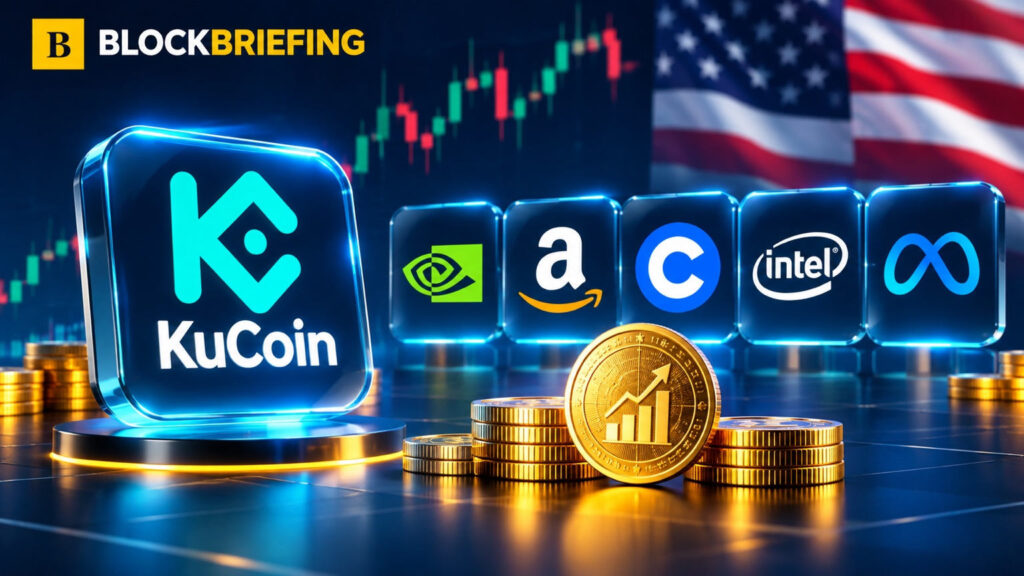
Cryptocurrency exchange KuCoin has expanded its tokenized equity offering by announcing five US stock-linked assets, including products representing Nvidia, Amazon and Coinbase, as demand grows for blockchain-based exposure to traditional financial markets.
In an official announcement dated November 2, the exchange confirmed the addition of Amazon xStock (AMZNX), Coinbase xStock (COINX), Intel xStock (INTCX), Meta xStock (METAX) and Nvidia xStock (NVDAX).
The products were scheduled to trade against  USDT market price and chart, with deposits supported through the
 Solana market price and chart network. Their availability remains subject to geographic restrictions and product-specific risks.
KuCoin Sets Trading Schedule for Five xStocks
KuCoin divided the listings into two trading sessions on November 2. The AMZNX/USDT, COINX/USDT and METAX/USDT pairs were scheduled to open at 10:00 UTC, following a one-hour call auction beginning at 09:00 UTC.
The remaining INTCX/USDT and NVDAX/USDT pairs were scheduled to begin trading at 11:00 UTC, with their corresponding call auctions running from 10:00 to 11:00 UTC.
Deposits were enabled using Solana’s SPL token standard. KuCoin also announced support for automated trading products, including Spot Grid, Dollar-Cost Averaging, Infinity Grid, Smart Rebalance and selected AI-assisted trading strategies.
These tools automate orders according to predefined settings. Their availability does not eliminate trading losses, liquidity risks or market volatility.
How Tokenized US Stocks Work
The newly listed instruments belong to the xStocks ecosystem, which provides blockchain-based representations of publicly traded equities and exchange-traded funds. According to KuCoin, each xStock is backed one-to-one by the corresponding underlying asset held with a regulated custodian.
The structure is intended to provide eligible users economic exposure to traditional securities through transferable digital tokens. Tokenized equity exposure, however, should not automatically be treated as identical to owning shares directly through a traditional brokerage.
Investor rights, corporate actions, redemption procedures and custody protections depend on the token’s legal structure and documentation. Potential investors should examine product terms, issuer disclosures and redemption conditions rather than relying solely on the underlying company’s name.
Solana compatibility can enable transfers through supported blockchain infrastructure, although KuCoin’s announcement does not establish unrestricted transfers or integration with every decentralized application.
Geographic Restrictions Limit Access
KuCoin’s announcement lists jurisdictions where trading these products is prohibited, including the United States, United Kingdom, Canada, Australia, Japan, Singapore, Hong Kong and several European countries.
The restrictions illustrate the difference between the technical existence of a token on a public blockchain and the legal availability of a regulated investment product. Users should verify eligibility with the exchange before depositing or buying.
Tokenization Expands Across Crypto Markets
The listings add to efforts connecting digital-asset platforms with traditional securities. BlockBriefing previously reported that Solana tokenized stock wallets surpassed 1.5 million, highlighting interest in on-chain financial exposure.
Separately, proposed tokenized stock listings have prompted objections from traditional companies, raising questions around authorization and shareholder protections.
KuCoin’s additions demonstrate how exchanges are extending investment-linked products beyond cryptocurrencies. Whether these listings attract sustained activity will depend on liquidity, demand, regulatory constraints and confidence in custody arrangements.